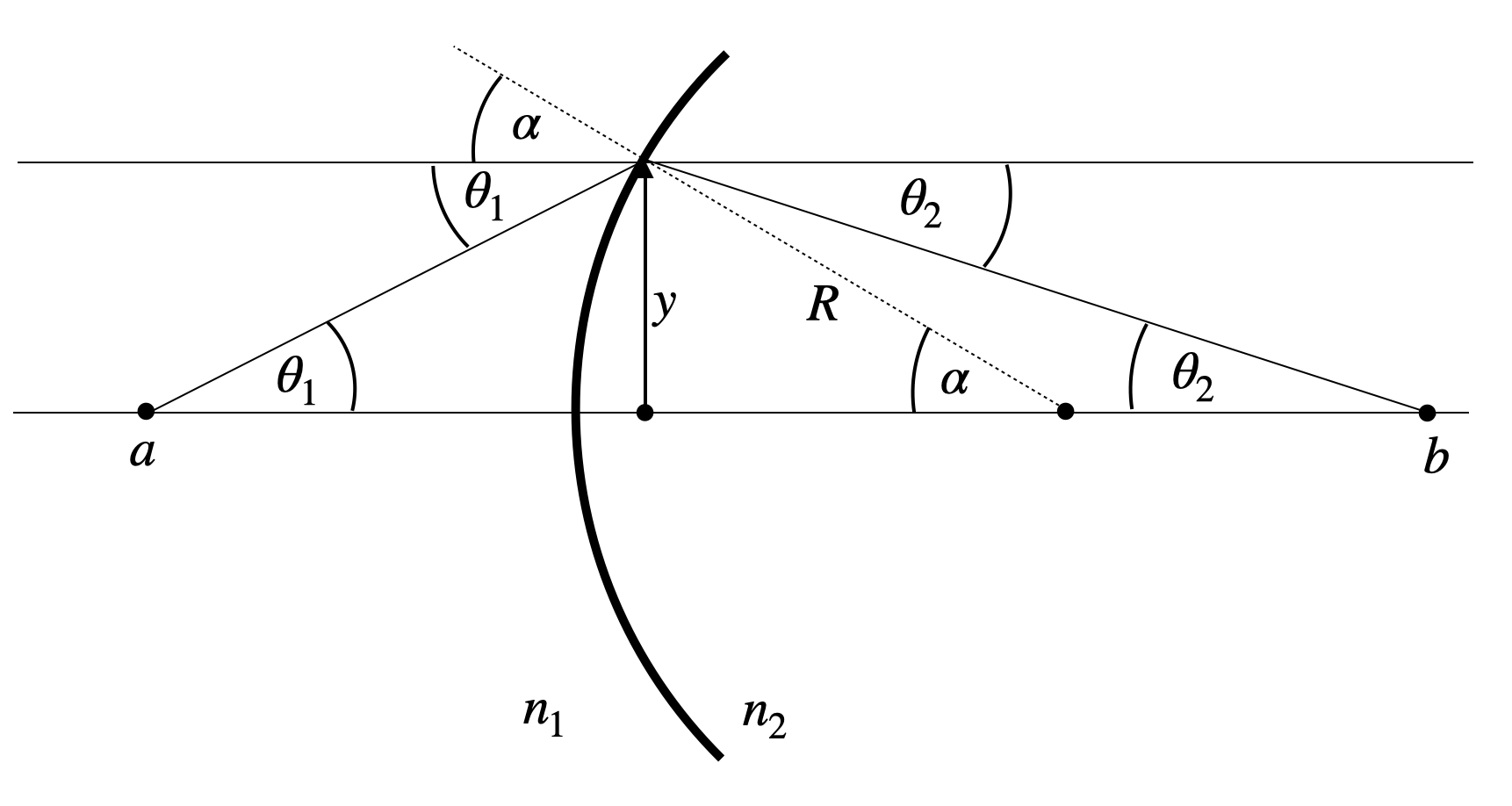
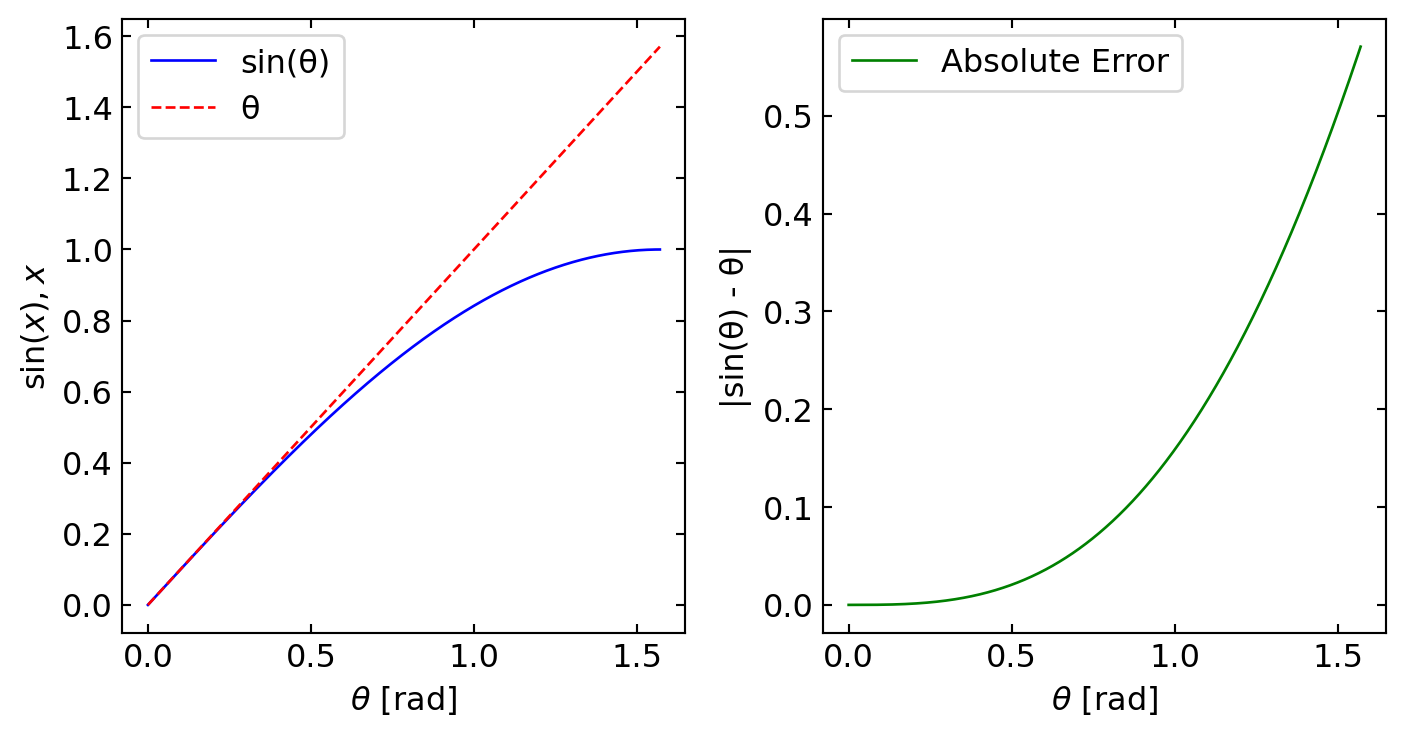
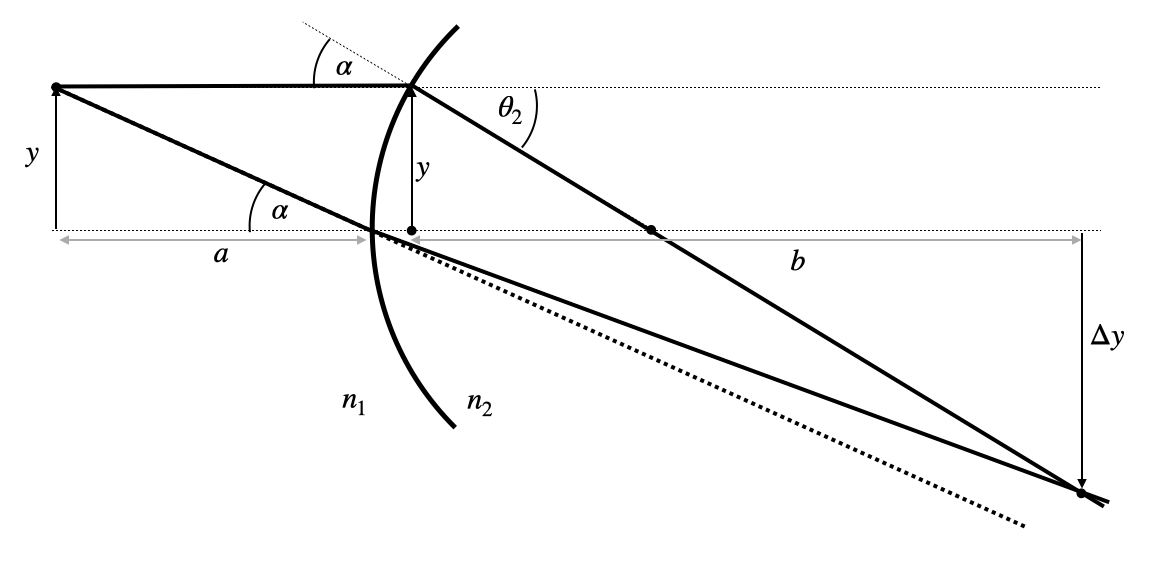
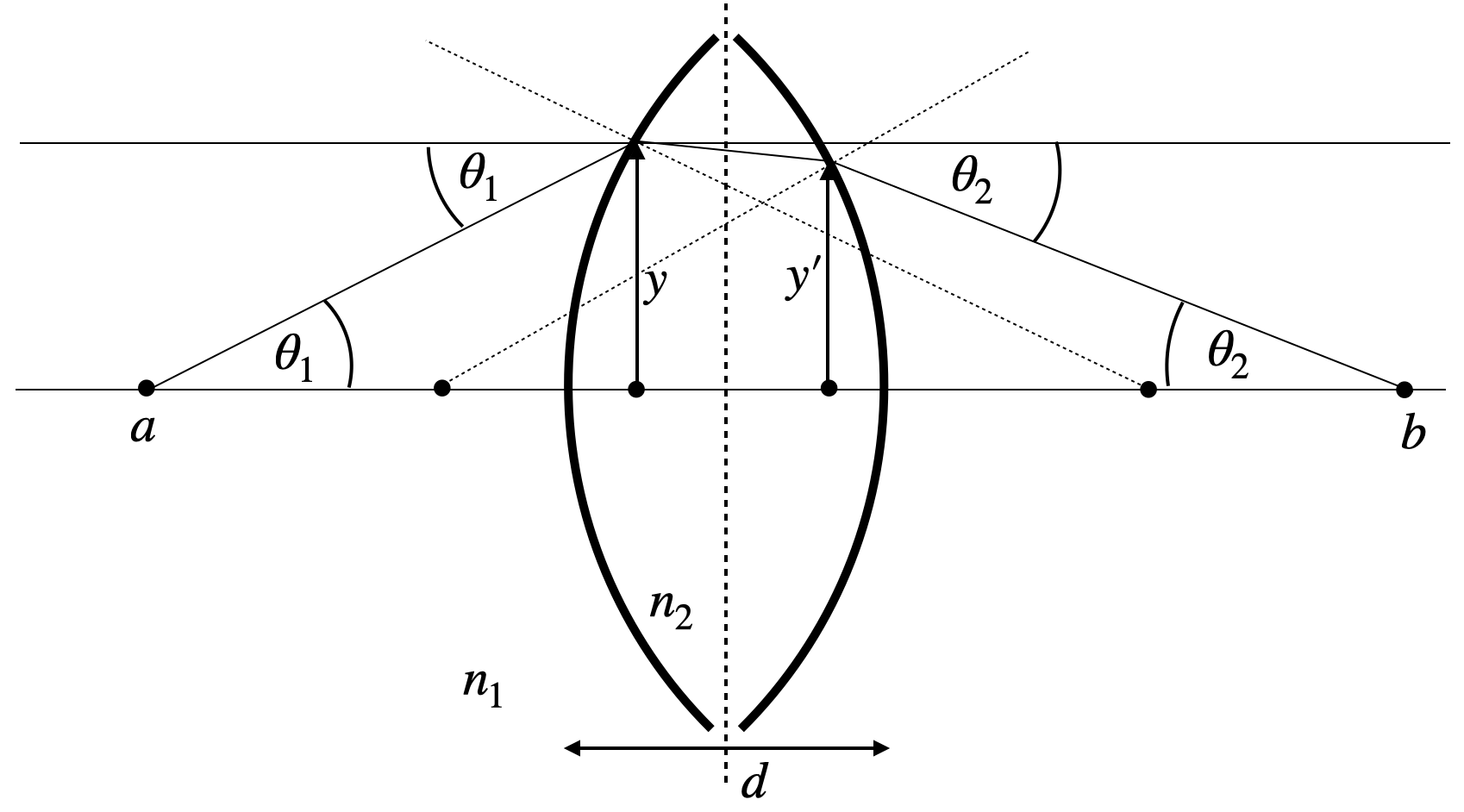
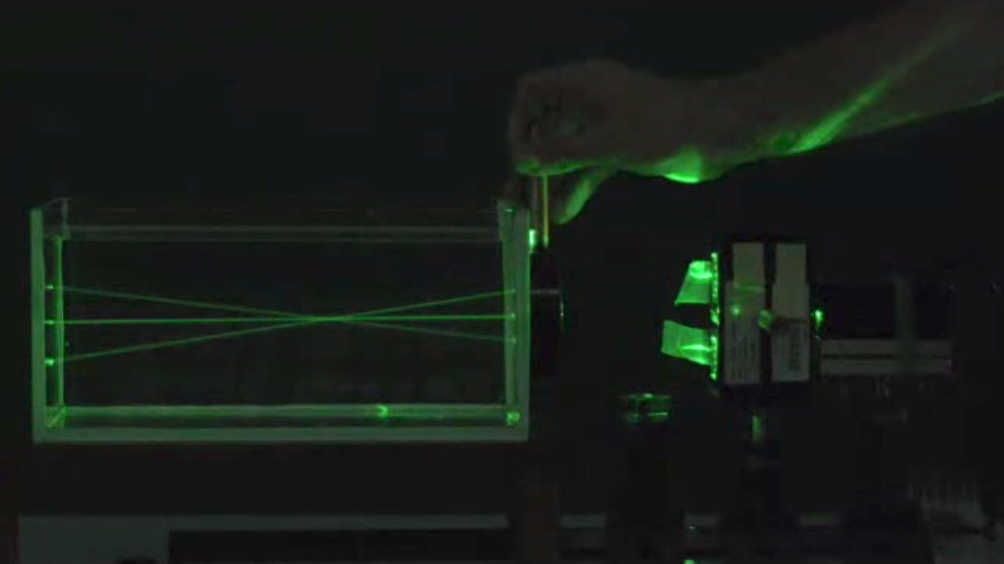
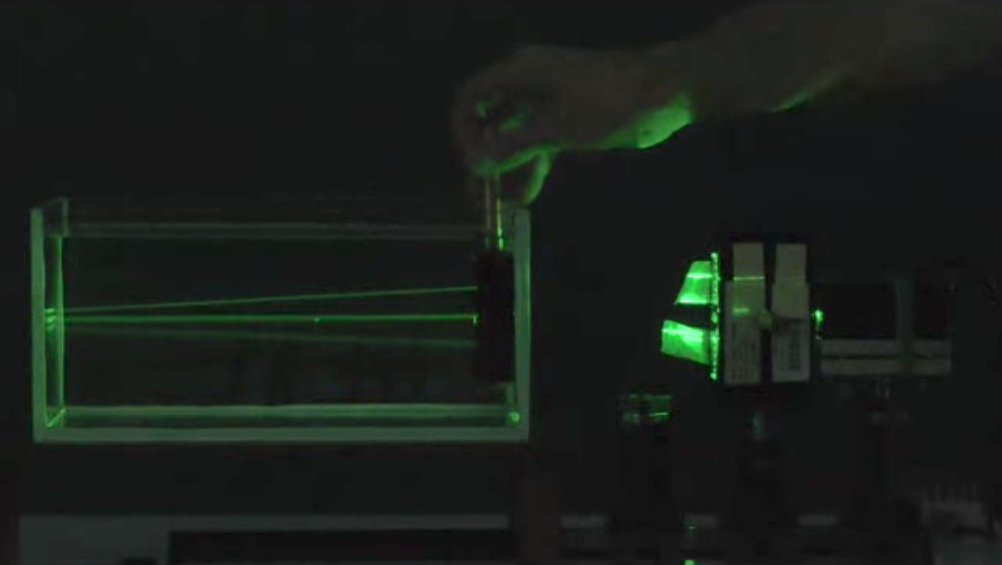
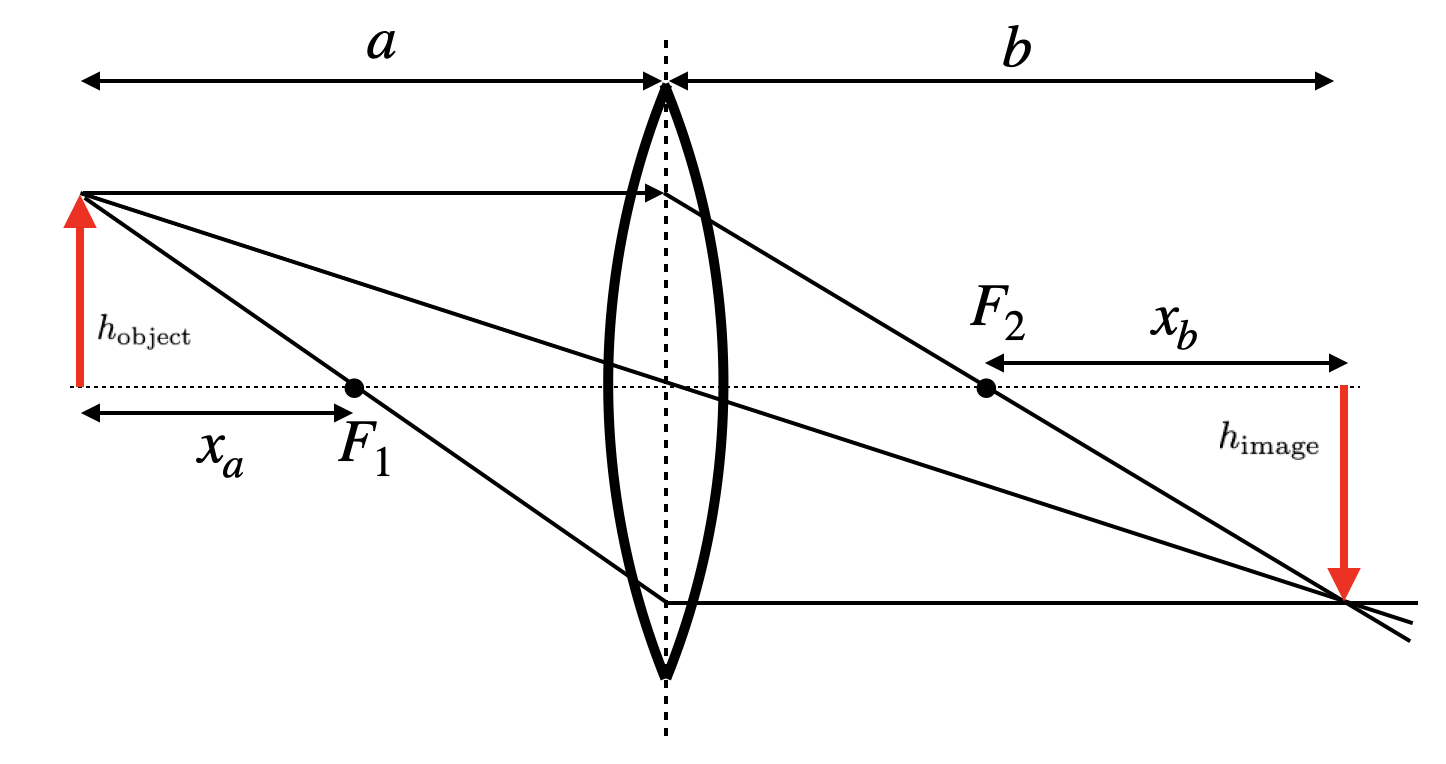
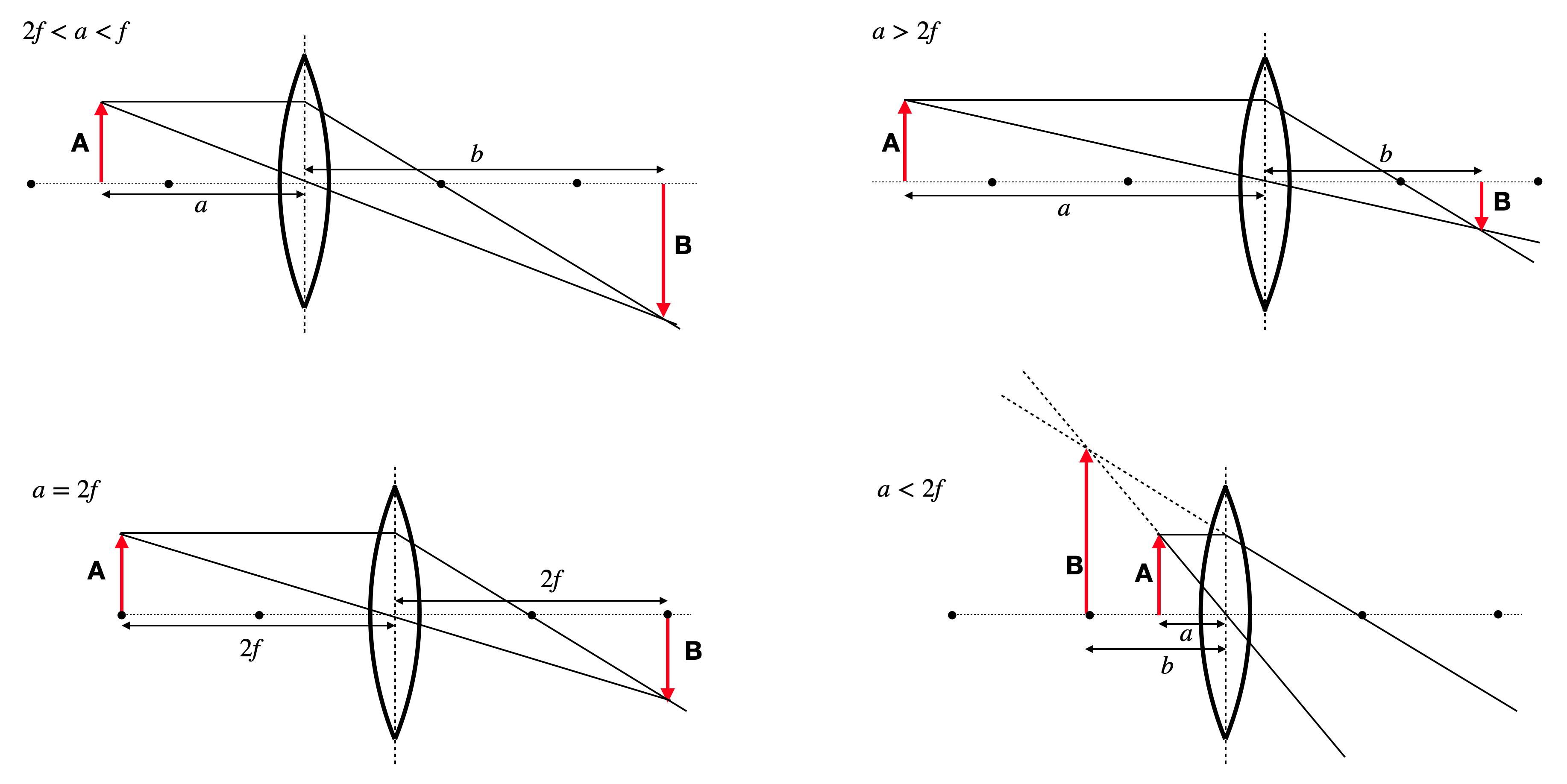
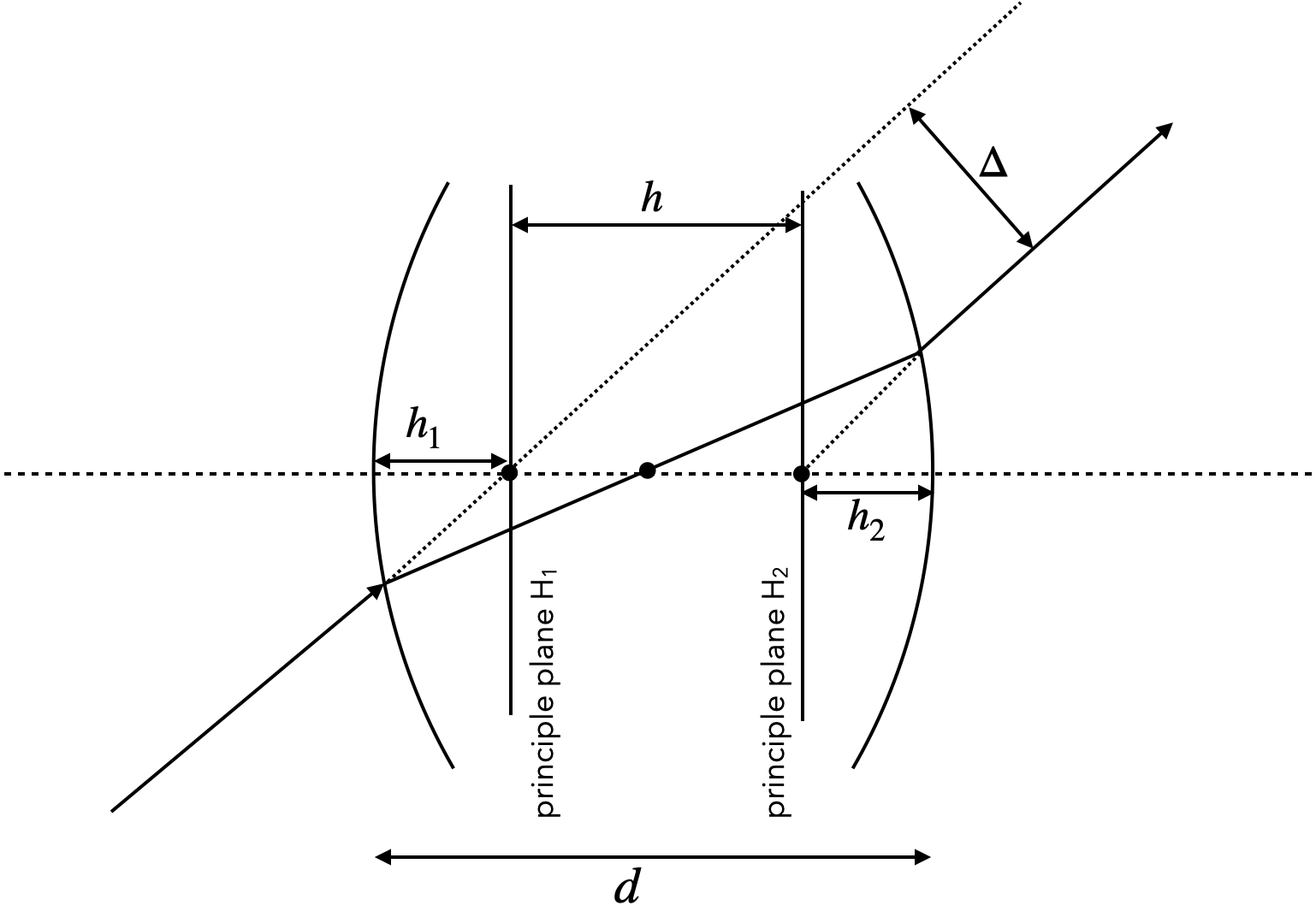
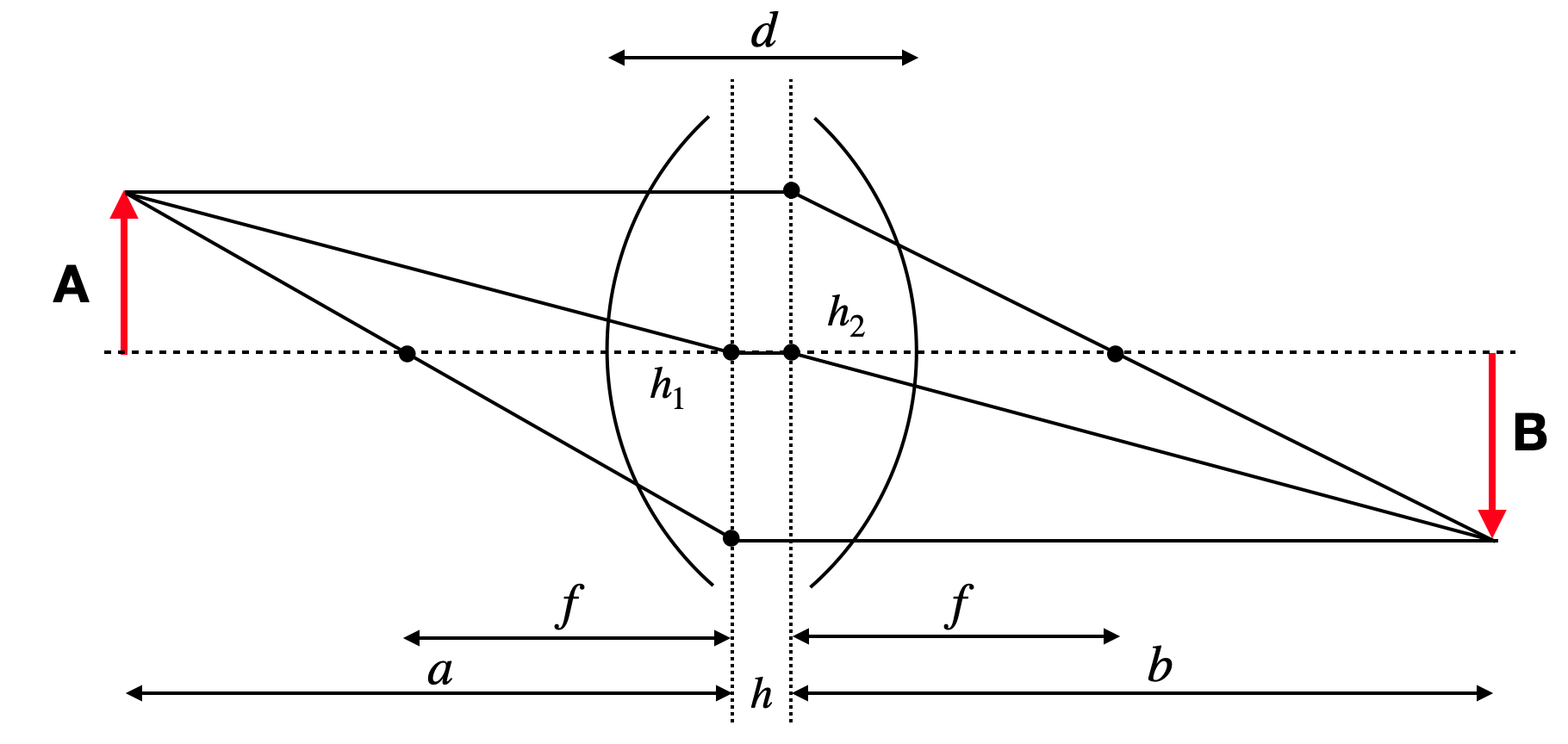
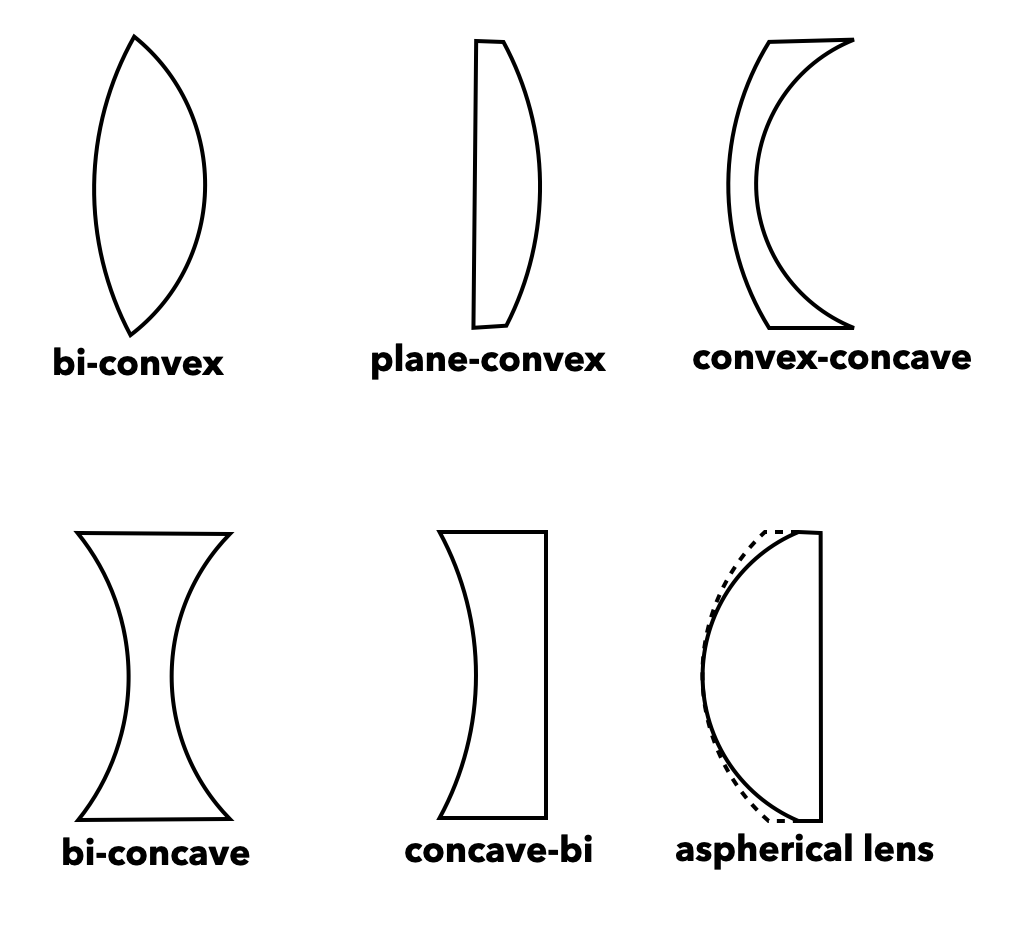
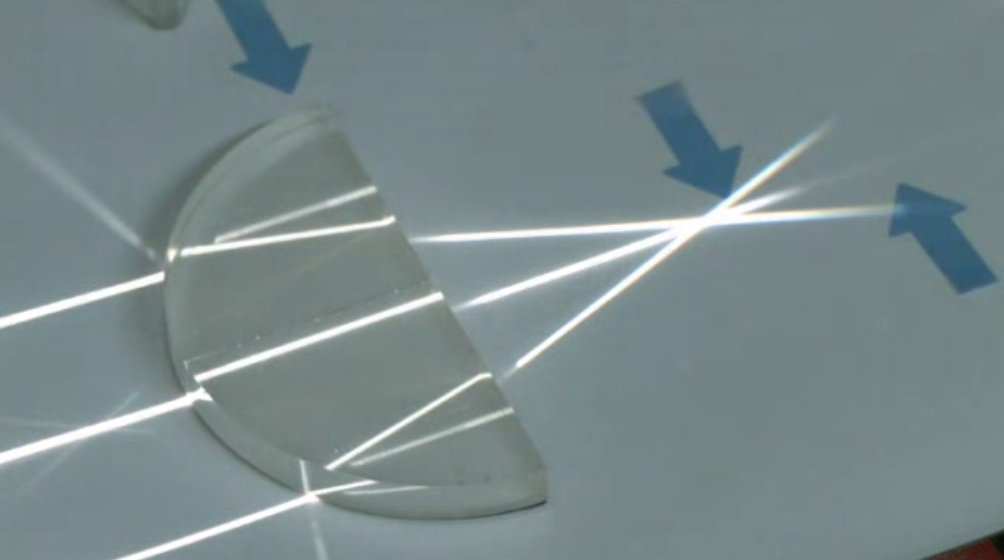
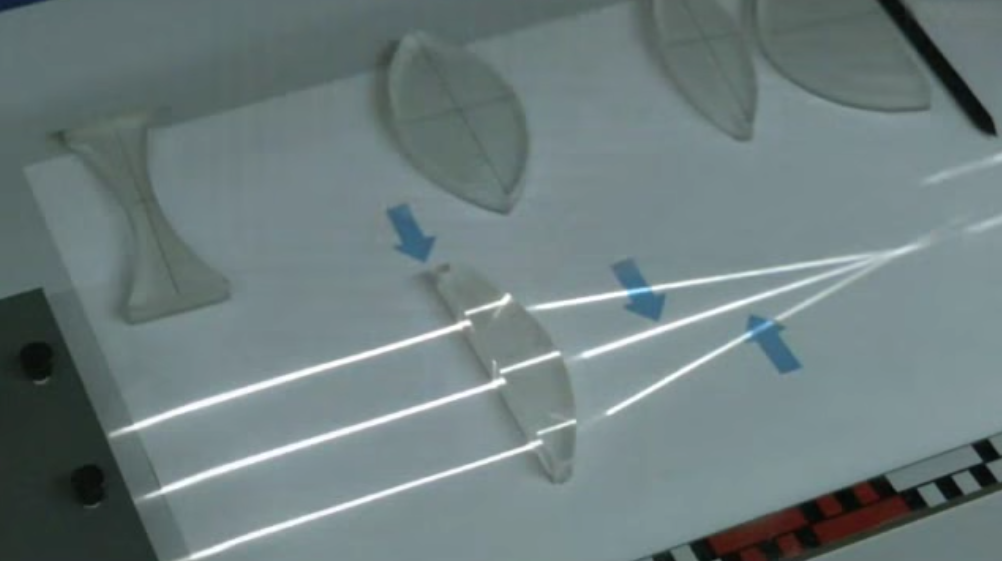
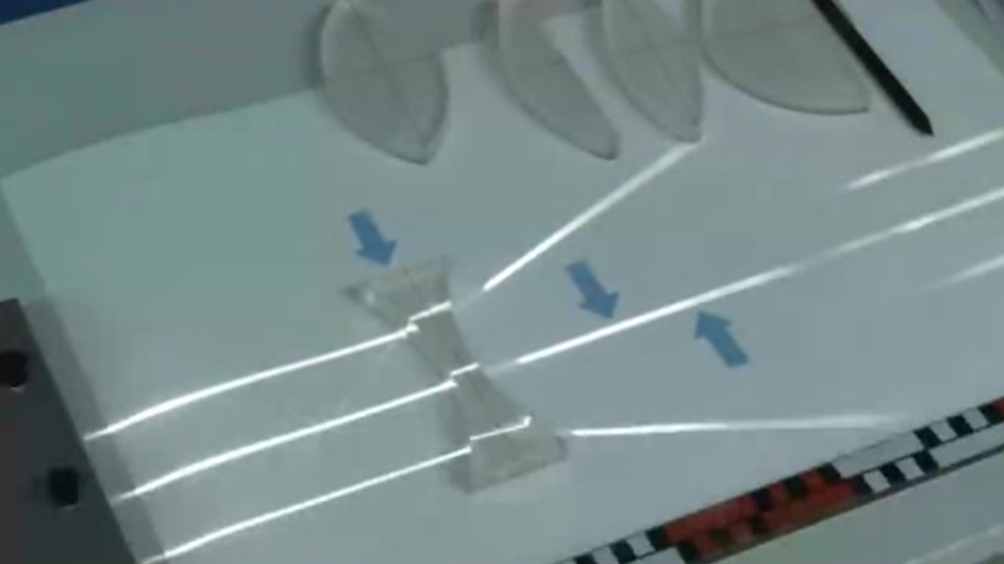
The above derived equations for a single spherical surface yield a linear relation between the input variables \(y_1\) and \(\theta_1\) and the output variables \(y_2\) and \(\theta_2\). The linear relation yields a great opportunity to express optical elements in terms of linear transformations (matrices). This is the basis of matrix optics. The matrix representation of a lens is given by
\[\begin{pmatrix} y_2 \\ \theta_2 \end{pmatrix} = \begin{pmatrix} 1 & 0 \\ -\frac{1}{f} & 1 \end{pmatrix} \begin{pmatrix} y_1 \\ \theta_1 \end{pmatrix}\]
where the matrix is called the ABCD matrix of the lens. Due to the linearization of Snells law w can write down more generally
\[\begin{pmatrix} y_2 \\
\theta_2 \end{pmatrix} = \begin{pmatrix} A & B \\ C & D \end{pmatrix} \begin{pmatrix} y_1 \\ \theta_1 \end{pmatrix}\]
and one can obtain a Matrix for all types of optical elements such as free space of dustance \(d\).
\[\begin{bmatrix}
A & B\\
C & D
\end{bmatrix}
=
\begin{bmatrix}
1 & d\\
0 & 1
\end{bmatrix}
\]
The physical meaning of the ABCD matrix elements can be understood as follows:
| A |
Relates output height to input height (magnification-like effect) |
| B |
Relates output height to input angle (how much an angled ray displaces) |
| C |
Relates output angle to input height (optical power, focusing/defocusing) |
| D |
Relates output angle to input angle (angular magnification) |
Here are some useful matrices for optical elements:
\[
\mathbf{M}=\left[\begin{array}{ll}
1 & d \\
0 & 1
\end{array}\right] \tag{Free space}
\]
\[
\mathbf{M}=\left[\begin{array}{cc}
1 & 0 \\
0 & \frac{n_1}{n_2}
\end{array}\right] \tag{Planar interface}
\]
\[
\mathbf{M}=\left[\begin{array}{cc}
1 & 0 \\
-\frac{\left(n_2-n_1\right)}{n_2 R} & \frac{n_1}{n_2}
\end{array}\right] \tag{Spherical Boundary}
\]
\[
\mathbf{M}=\left[\begin{array}{cc}
1 & 0 \\
-\frac{1}{f} & 1
\end{array}\right] \tag{Tin Lens}
\]
If we have now a system of optical elements, we can multiply the matrices of the individual elements to obtain the matrix of the whole system.
\[
\rightarrow \mathrm{M}_1 \rightarrow \mathrm{M}_2 \rightarrow \mathrm{M}_N \rightarrow \mathrm{M}=\mathbf{M}_N \ldots \mathrm{M}_2 \mathbf{M}_1 \text {. }
\]
This is a very powerful tool to analyze optical systems.
Example: Two-Lens System
Consider a system consisting of two thin lenses separated by a distance \(d\). The first lens has focal length \(f_1 = 100\) mm and the second lens has focal length \(f_2 = 150\) mm, separated by \(d = 200\) mm. We want to find the overall system matrix and determine where a parallel ray at height \(y_1 = 10\) mm crosses the optical axis.
The system consists of three components: 1. First lens with matrix \(\mathbf{M}_1\) 2. Free space propagation of distance \(d\) with matrix \(\mathbf{M}_{\text{free}}\) 3. Second lens with matrix \(\mathbf{M}_2\)
The individual matrices are:
\[
\mathbf{M}_1 = \begin{bmatrix} 1 & 0 \\ -\frac{1}{f_1} & 1 \end{bmatrix}, \quad
\mathbf{M}_{\text{free}} = \begin{bmatrix} 1 & d \\ 0 & 1 \end{bmatrix}, \quad
\mathbf{M}_2 = \begin{bmatrix} 1 & 0 \\ -\frac{1}{f_2} & 1 \end{bmatrix}
\]
The total system matrix is:
\[
\mathbf{M}_{\text{total}} = \mathbf{M}_2 \cdot \mathbf{M}_{\text{free}} \cdot \mathbf{M}_1
\]
Performing the matrix multiplication:
\[
\mathbf{M}_{\text{total}} = \begin{bmatrix} 1 & 0 \\ -\frac{1}{f_2} & 1 \end{bmatrix} \begin{bmatrix} 1 & d \\ 0 & 1 \end{bmatrix} \begin{bmatrix} 1 & 0 \\ -\frac{1}{f_1} & 1 \end{bmatrix}
\]
\[
= \begin{bmatrix} 1 & 0 \\ -\frac{1}{f_2} & 1 \end{bmatrix} \begin{bmatrix} 1 - \frac{d}{f_1} & d \\ -\frac{1}{f_1} & 1 \end{bmatrix}
\]
\[
= \begin{bmatrix} 1 - \frac{d}{f_1} & d \\ -\frac{1}{f_2} - \frac{1}{f_1} + \frac{d}{f_1 f_2} & 1 - \frac{d}{f_2} \end{bmatrix}
\]
For our specific values (\(f_1 = 100\) mm, \(f_2 = 150\) mm, \(d = 200\) mm):
\[
\mathbf{M}_{\text{total}} = \begin{bmatrix} -1 & 200 \\ -0.00333 & -0.333 \end{bmatrix}
\]
For a parallel ray at height \(y_1 = 10\) mm (i.e., \(\theta_1 = 0\)):
\[
\begin{pmatrix} y_2 \\ \theta_2 \end{pmatrix} = \begin{bmatrix} -1 & 200 \\ -0.00333 & -0.333 \end{bmatrix} \begin{pmatrix} 10 \\ 0 \end{pmatrix} = \begin{pmatrix} -10 \\ -0.0333 \end{pmatrix}
\]
The ray exits at height \(y_2 = -10\) mm with angle \(\theta_2 = -0.0333\) rad. The ray crosses the optical axis at a distance:
\[
b = -\frac{y_2}{\theta_2} = -\frac{-10}{-0.0333} = -300 \text{ mm}
\]
This means the focal point is 300 mm before the second lens (a virtual focus). This example demonstrates how matrix optics simplifies the analysis of complex multi-element optical systems.