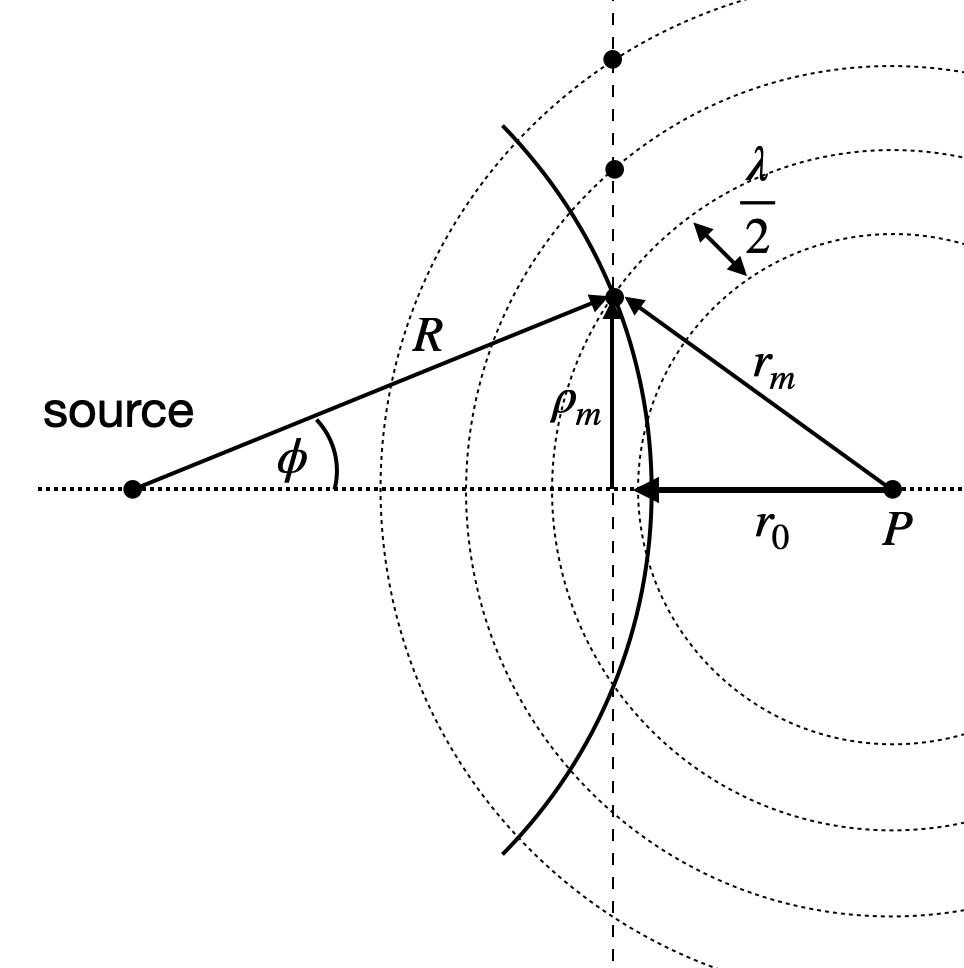
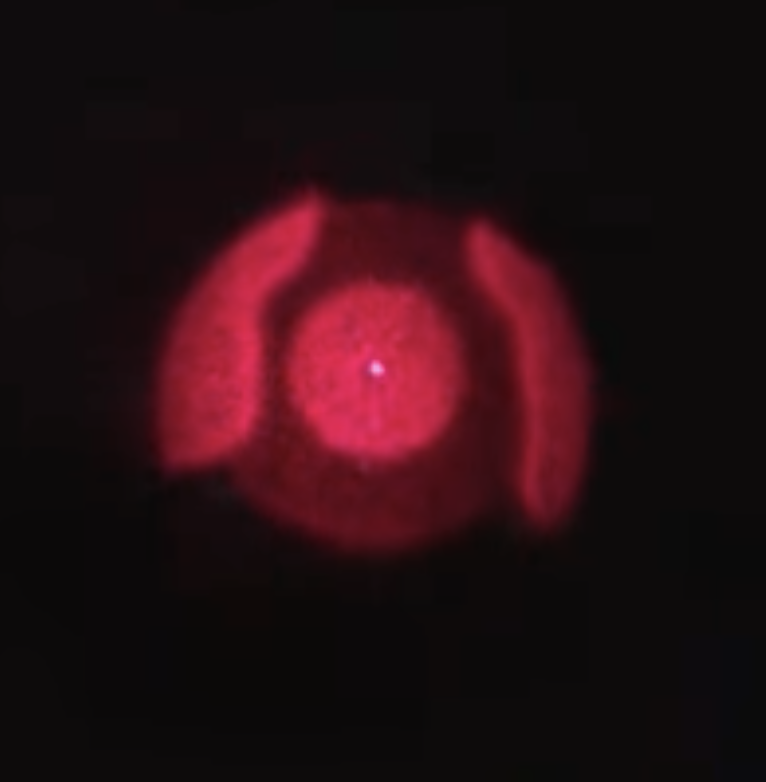
We want to take a more general look at diffraction by exploring a concept known as Fresnel zones. Consider spherical waves of wavelength \(\lambda\) emitted from a source, as indicated by the solid line in the sketch below.
Construction of the Fresnel Zones.
We will examine the intensity of the wave at a point \(P\). To do this, we consider the amplitude contributions from all points on the wavefront, as each point on the wavefront acts as a Huygens source contributing to the intensity at point \(P\).
Instead of calculating the intensity explicitly, we will analyze the distances of individual points on the wavefront from point \(P\). Specifically, we look at concentric circles around point \(P\), where the radius of each circle increases by \(\lambda/2\), i.e.,
\[
r_m = r_0 + m \frac{\lambda}{2}
\]
where \(m\) is an integer. The regions between \(r_m\) and \(r_{m+1}\) are called Fresnel zones. If we consider two neighboring zones, each zone contains pairs of points that are exactly \(\lambda/2\) out of phase. This means that these pairs of points would lead to destructive interference. If we remove these points, we are left with constructive interference along the optical axis only. We can construct such an aperture by calculating the ring radius
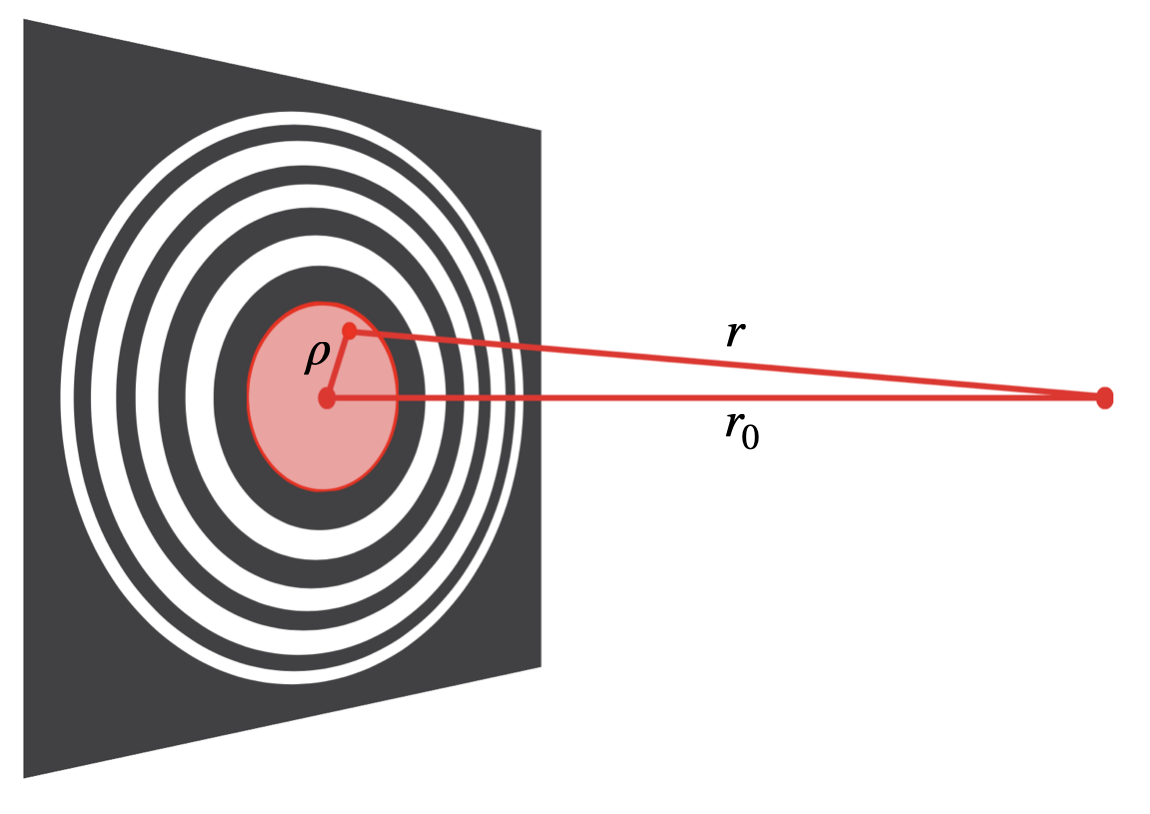
If we now fill the ring from \(\rho_m\) to \(\rho_{m+1}\) on a glass slide but leave the ring from \(\rho_{m+1}\) to \(\rho_{m+2}\) transparent, we create a so-called Fresnel zone plate. Here, the radius in the first zone \(r\) ranges from \(r_0\) to \(r_0 + \lambda/2\). The next zone will range from \(r_0 + \lambda/2\) to \(r_0 + \lambda\) but is removed from its contribution to the point.
Fresnel zone plate removing destructive interference to the point on the optical axis.
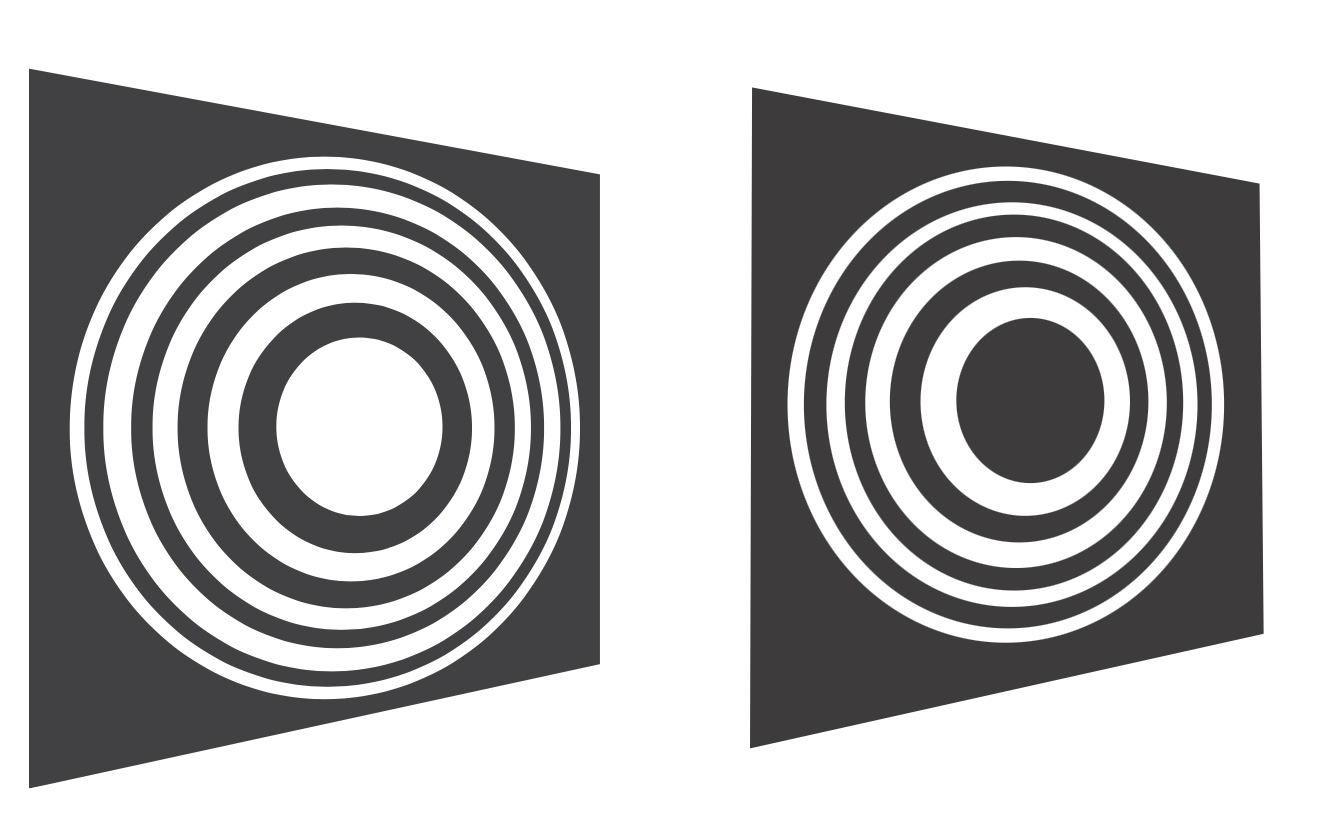
The Fresnel zone plate can be constructed by defining the inner reference zone in an arbitrary way. One may either block or transmit the direct path from the light source along the optical axis, resulting in either the odd or even zones being transparent.
Fresnel zone plates with odd (left) or even (right) zones transparent delivering the same result.
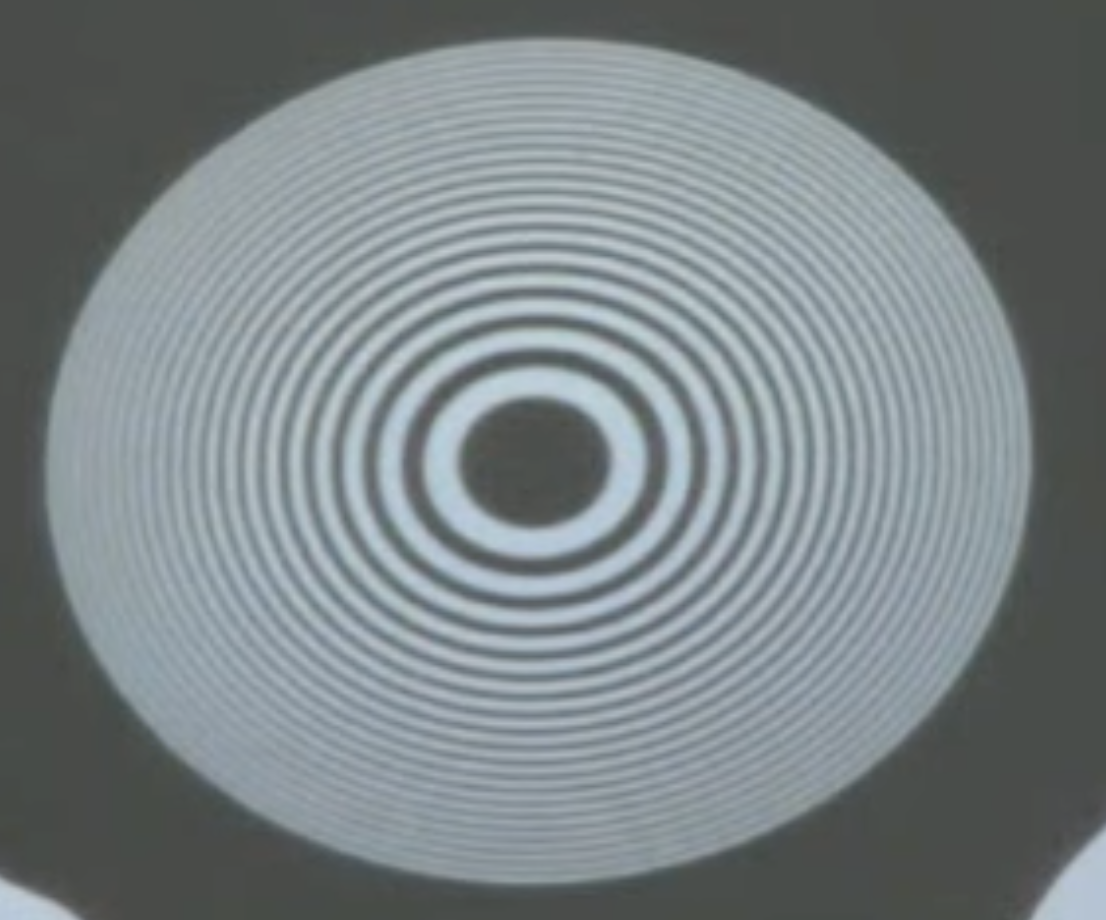
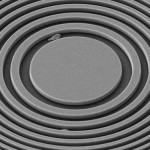
Such zone plates are important for applications where focusing of radiation is required but the refractive indices are not large enough to create strong enough refraction. This is especially true for X-ray radiation.
Fresnel zone plates for X-ray radiation. Image taken from Ion beam lithography for Fresnel zone plates in X-ray microscopy - Optics Express, Vol. 21 Issue 10, pp.11747-11756 (2013).
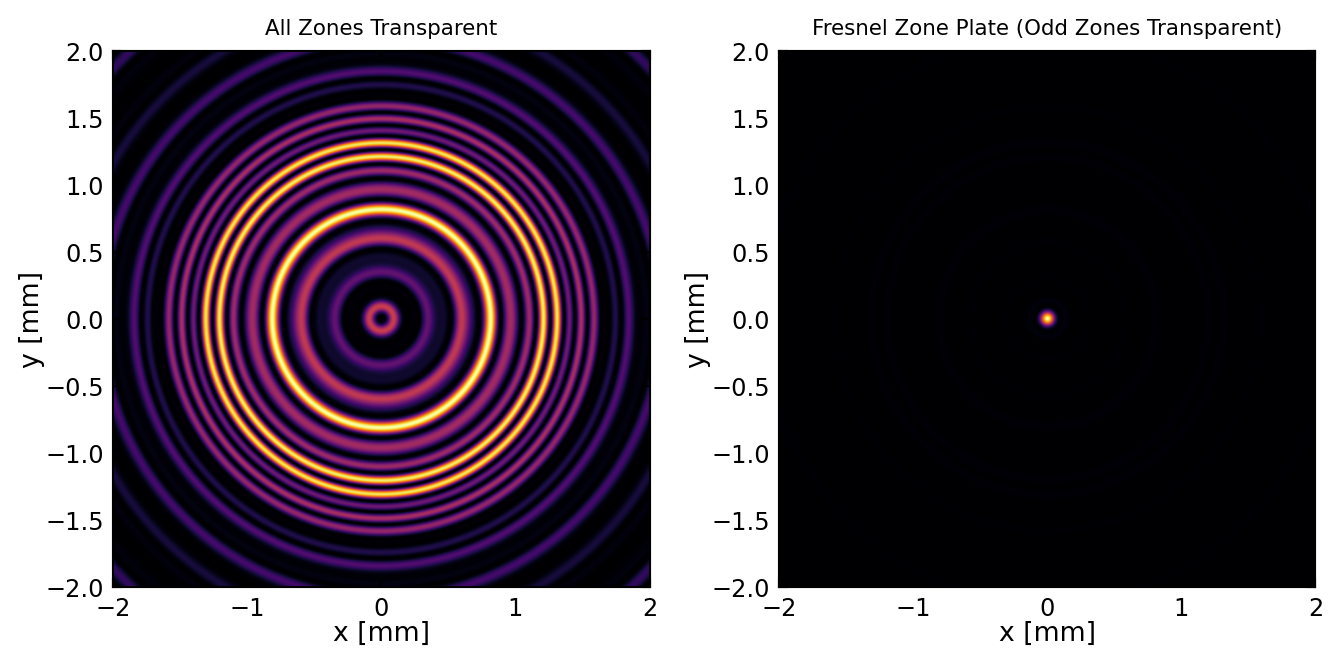
Below is a calculation of the intensity pattern at the focal distance of a zone plate from many spherical wave sources if the destructively interfering waves are not removed (left) and if they are removed.
Code
def spherical_wave(k, omega, r, r0, t): d = np.linalg.norm(r - r0[:, np.newaxis, np.newaxis], axis=0)return np.exp(1j* (k * d - omega * t)) / dwavelength =532e-9# Wavelength of light (532 nm)k0 =2* np.pi / wavelength # Wave numberc =299792458# Speed of light in m/somega0 = k0 * c # Angular frequencyt =0# Time# Observation plane at the focal distance r0r0 =0.5# 0.5 m (50 cm)# Create observation grid at z = 0 (focal plane)x = np.linspace(-2e-3, 2e-3, 800)y = np.linspace(-2e-3, 2e-3, 800)X, Y = np.meshgrid(x, y)r = np.array([X, Y, np.zeros_like(X)]) # Observation points at z = 0num_zones =10m_values = np.arange(1, num_zones +1) # m from 1 to num_zonesrho_m = np.sqrt(m_values * r0 * wavelength) # Radii of the zonespoints_per_zone =200# Adjust for performance vs. accuracytotal_field_all = np.zeros_like(X, dtype=complex)total_field_zone_plate = np.zeros_like(X, dtype=complex)# Loop over zonesfor idx, m inenumerate(m_values):# Angle positions around the ring theta = np.linspace(0, 2* np.pi, points_per_zone, endpoint=False)# Radius of the current zone radius = rho_m[idx]# Source positions on the ring (in the aperture plane at z = -r0) x0 = radius * np.cos(theta) y0 = radius * np.sin(theta) z0 =-r0 * np.ones_like(x0) # All sources in the aperture plane at z = -r0# Sources array sources = np.array([x0, y0, z0])# Field contributions from this zone field_zone = np.zeros_like(X, dtype=complex)# Sum contributions from all sources in the zonefor i inrange(sources.shape[1]): r0_source = sources[:, i] field = spherical_wave(k0, omega0, r, r0_source, t) field_zone += field# Add to total field for all zones total_field_all += field_zone# Add to total field for zone plate if zone is odd-numberedif m %2==1: # m is odd (1, 3, 5, ...) total_field_zone_plate += field_zone# Compute intensitiesintensity_all = np.abs(total_field_all)**2intensity_zone_plate = np.abs(total_field_zone_plate)**2# Normalize intensities for better comparisonintensity_all /= np.max(intensity_all)intensity_zone_plate /= np.max(intensity_zone_plate)# Plottingfig, axs = plt.subplots(1, 2, figsize=get_size(18, 10))extent = [np.min(x)*1e3, np.max(x)*1e3, np.min(y)*1e3, np.max(y)*1e3] # in mm# All zones transparentim1 = axs[0].imshow(intensity_all, extent=extent, origin='lower', cmap='inferno')axs[0].set_title('All Zones Transparent')axs[0].set_xlabel('x [mm]')axs[0].set_ylabel('y [mm]')#plt.colorbar(im1, ax=axs[0], label='Normalized Intensity')# Fresnel Zone Plateim2 = axs[1].imshow(intensity_zone_plate, extent=extent, origin='lower', cmap='inferno')axs[1].set_title('Fresnel Zone Plate (Odd Zones Transparent)')axs[1].set_xlabel('x [mm]')axs[1].set_ylabel('y [mm]')#plt.colorbar(im2, ax=axs[1], label='Normalized Intensity')plt.tight_layout()plt.show()
Intensity pattern at the focal plane with all zones contributing (left) versus with only odd zones contributing (right).
Applications and Importance of Fresnel Zone Plates
Fresnel zone plates are used in various applications, particularly where traditional lenses are ineffective. Some key applications include:
X-ray Microscopy: Fresnel zone plates are used to focus X-rays, which have very short wavelengths and require special techniques for focusing. Traditional lenses are not effective for X-rays due to their low refractive indices.
Optical Systems: In optical systems, Fresnel zone plates can be used to create focal points without the need for bulky lenses. This is particularly useful in compact optical devices.
Holography: Fresnel zone plates are used in holography to create and reconstruct holograms. They help in manipulating the wavefronts to produce the desired holographic images.
Astronomy: In astronomy, Fresnel zone plates can be used in telescopes to focus light from distant stars and galaxies. They offer an alternative to traditional lenses and mirrors.