Microscopy II: Phase Contrast and Fluorescence

Microscopy II: Phase Contrast and Fluorescence

Introduction: Why Phase Contrast?

In the previous lecture on conventional brightfield microscopy and Fourier optics, we learned that microscopy resolution is fundamentally limited by diffraction. However, there exists an equally important problem that afflicts transparent biological specimens: the phase problem.

Most living cells and organelles are nearly transparent—they have refractive indices very close to that of water (\(n \approx 1.33\)). This means they scatter very little light and produce virtually no contrast in brightfield microscopy, even though they strongly interact with light through phase shifts. We cannot simply “turn up the brightness” to see transparent cells; we need to convert invisible phase variations into visible amplitude (intensity) variations.

This lecture explores several elegant optical techniques that solve the phase problem, ultimately enabling us to visualize subcellular structures and to perform 3D imaging with fluorescence. These techniques form the foundation of modern biomedical microscopy.


1. The Phase Problem and Transparent Specimens

1.1 Mathematical Description of Phase Objects

When light passes through a thin transparent specimen, it is transmitted with a phase shift but negligible amplitude attenuation. We can describe the transmitted field as:

\[ \mathcal{E}_{\text{trans}}(x,y) = A_0 \, t(x,y) = A_0 \, e^{i\phi(x,y)} \]

where: - \(A_0\) is the incident field amplitude (constant) - \(t(x,y) = e^{i\phi(x,y)}\) is the transmittance (a pure phase modulation) - \(\phi(x,y)\) is the phase shift introduced by the specimen

The phase shift is related to the optical path length through the specimen:

\[ \phi(x,y) = \frac{2\pi}{\lambda} \int_0^h [n(x,y,z) - n_0] \, dz \]

where \(n(x,y,z)\) is the refractive index of the specimen, \(n_0\) is the refractive index of the surrounding medium (typically 1.33 for water or 1.0 for air), and \(h\) is the thickness.

1.2 Why Transparent Specimens Are Invisible

The intensity recorded by a detector is:

\[ I = |\mathcal{E}_{\text{trans}}|^2 = |A_0|^2 \, |e^{i\phi(x,y)}|^2 = |A_0|^2 \]

Since \(|e^{i\phi}| = 1\) for any phase \(\phi\), the intensity is constant everywhere—completely independent of the phase shift! This is why transparent cells are invisible in brightfield microscopy: there is no amplitude contrast to detect.

However, for small phase shifts (\(\phi \ll 1\) radian), we can use the approximation:

\[ e^{i\phi} \approx 1 + i\phi \]

This suggests that if we could introduce additional amplitude variations that are proportional to \(\phi\), we could then visualize the phase structure. This is the central idea behind phase contrast microscopy.


2. Zernike Phase Contrast Microscopy

2.1 The Phase Contrast Principle

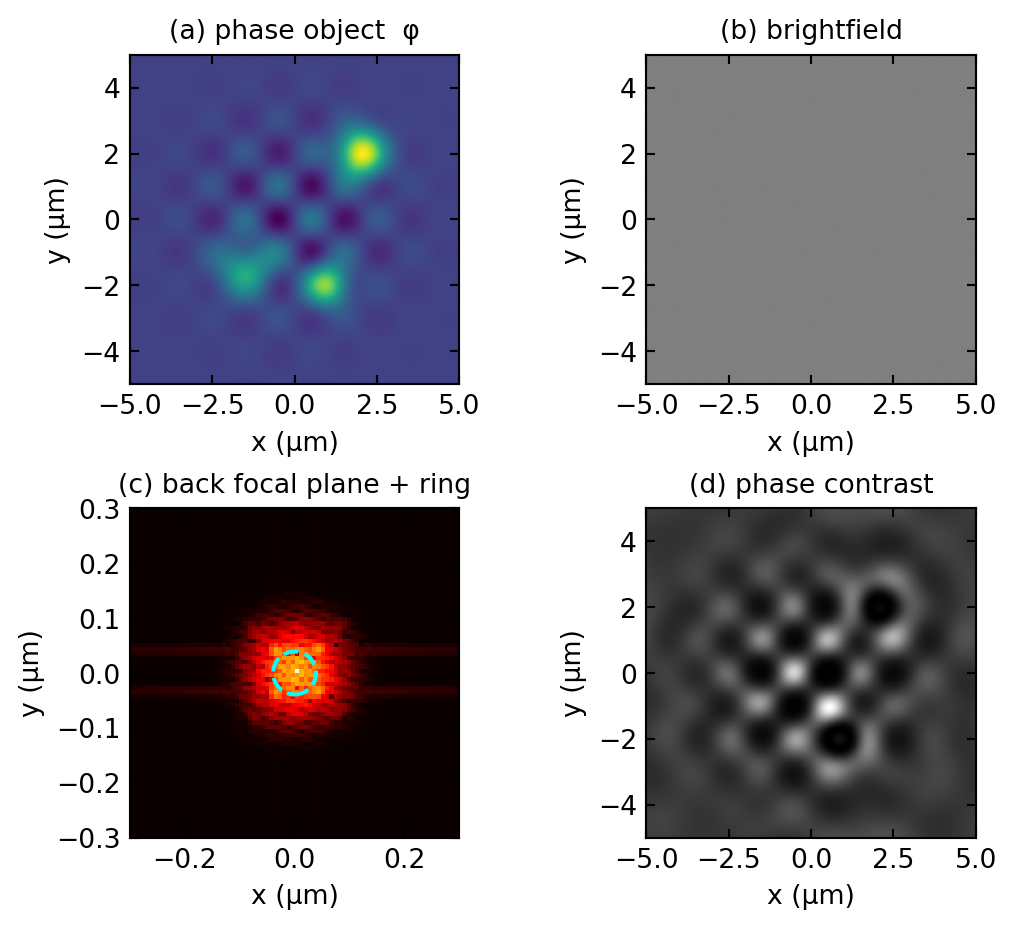
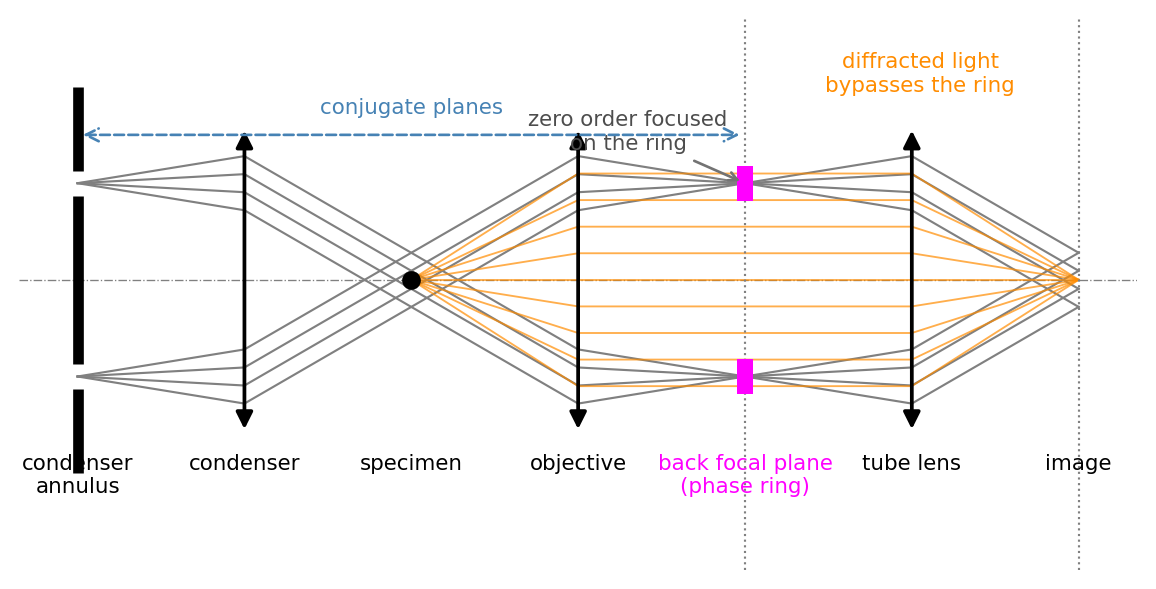
Fritz Zernike’s brilliant insight was to manipulate the light in the back focal plane (Fourier plane) of the microscope objective to convert phase variations into amplitude variations. The key steps are:

  1. Zero-order identification: The undiffracted (undeviated) light from the specimen forms the bright zero-order spot in the back focal plane. Light diffracted by the specimen forms higher-order diffraction patterns around it.

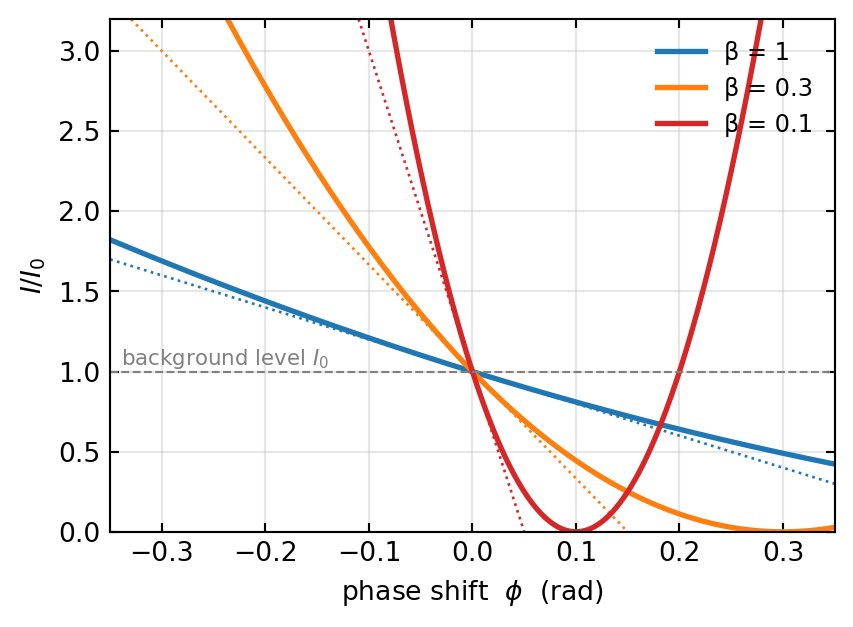
  2. Phase plate insertion: A phase ring is placed over the zero-order spot. This ring introduces a phase shift of \(\lambda/4\) (90°) and typically also reduces the amplitude of the zero-order by a factor of \(\beta\) (usually \(\beta \approx 0.1\)).

  3. Interference and contrast: The phase-shifted and attenuated zero-order light interferes with the diffracted orders, converting the phase modulation into intensity variations.

2.2 Mathematical Derivation of Phase Contrast

Let us analyze this more carefully. The field in the back focal plane (Fourier plane) is:

\[ E_{\text{BFP}}(u,v) = \mathcal{F}\{A_0 e^{i\phi(x,y)}\} \]

where \(\mathcal{F}\) denotes the Fourier transform and \((u,v)\) are spatial frequencies.

For a small phase object, using \(e^{i\phi} \approx 1 + i\phi\):

\[ E_{\text{BFP}} \approx A_0 \delta(u,v) + A_0 \mathcal{F}\{i\phi(x,y)\} \]

The first term is the zero-order (at the center), and the second term comprises the diffracted orders.

Without a phase plate, the intensity would be from the zero-order alone: \[ I_0 \propto A_0^2 \]

With a phase plate over the zero-order, we apply: \[ M(u,v) = \begin{cases} \beta e^{i\pi/2} & \text{at zero-order} \\ 1 & \text{elsewhere} \end{cases} \]

The field after the phase plate becomes: \[ E' = \beta A_0 e^{i\pi/2} + A_0 \mathcal{F}\{i\phi\} = i\beta A_0 + A_0 \mathcal{F}\{i\phi\} \]

Transforming back to the image plane and computing intensity (assuming weak phase object so cross terms dominate):

\[ I \approx |i\beta A_0 + A_0 \mathcal{F}\{i\phi\}|^2 \approx A_0^2 \left[\beta^2 + 2\beta \text{Im}\{\mathcal{F}\{i\phi\}\}\right] \]

In real space, this gives:

\[ I(x,y) \approx I_0 \left[1 + \frac{2\phi(x,y)}{\beta}\right] \]

where we used the convolution theorem and small-angle approximation. For typical phase contrast (\(\beta \approx 0.1\)):

\[ \boxed{I(x,y) \approx I_0(1 + 2\phi)} \]

Key result: The intensity now varies as the phase shift. Dark regions correspond to positive phase shifts (high refractive index), and bright regions correspond to negative phase shifts.

2.3 Positive and Negative Phase Contrast

  • Positive phase contrast: Zero-order phase shift is \(+\lambda/4\). Regions with positive phase (high \(n\)) appear dark. This is the standard configuration.
  • Negative phase contrast: Zero-order phase shift is \(-\lambda/4\). Regions with positive phase appear bright. Less commonly used.

2.4 Practical Considerations and Artifacts

Advantages: - Simple optical setup (requires only phase ring in turret) - Good contrast for weakly absorbing specimens - No staining required - Excellent for observing living cells

Artifacts and limitations: - Halo artifacts: Dark halo around bright structures due to the abrupt phase transition at specimen boundaries. This arises from edge diffraction. - Limited field of view: The phase ring must match the back aperture of the objective; different objectives require different phase plates. - Shading: Uneven illumination across field - Thickness dependent: Works best for thin specimens

The halo artifact can be understood as follows: at sharp boundaries of the specimen, there is a rapid phase gradient \(\nabla\phi\), which produces diffraction patterns that extend beyond the geometric size of the specimen.


3. Differential Interference Contrast (DIC / Nomarski)

3.1 Principle of DIC

While phase contrast has excellent contrast, its halo artifacts and limited field of view motivate alternative techniques. Differential interference contrast (DIC), also called Nomarski microscopy, provides an elegant solution.

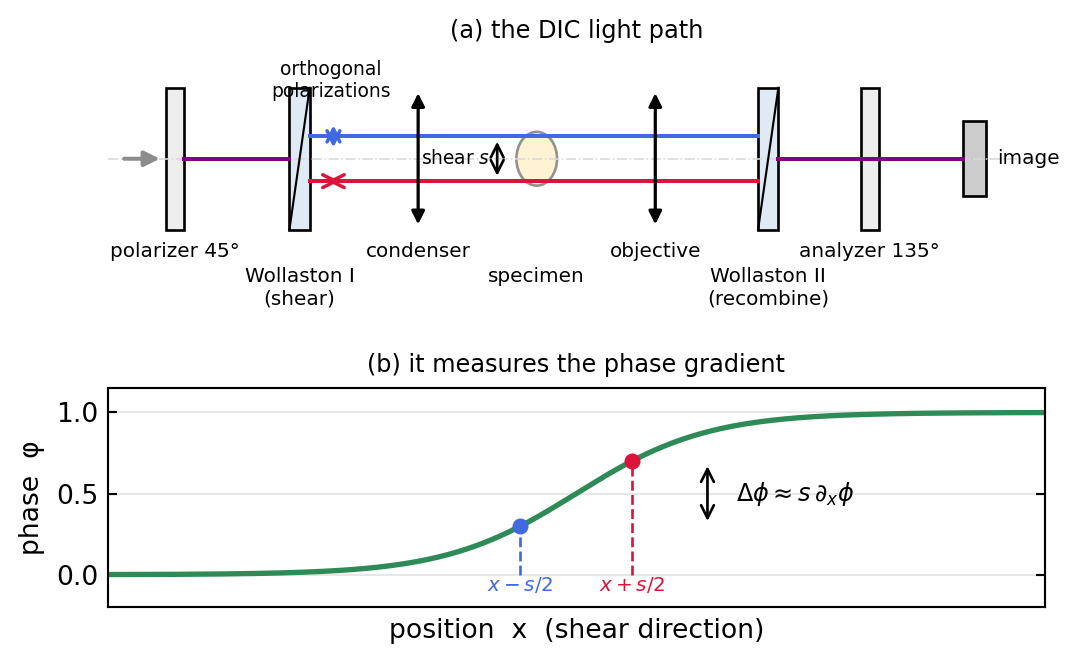
The basic principle is: 1. Use a birefringent prism (Wollaston prism) to split incident light into two orthogonally polarized beams 2. Introduce a lateral shear (typically \(\sim\!0.5\)\(2\) pixels) between these beams 3. These sheared beams traverse slightly different paths through the specimen 4. Recombine them at the analyzer (another Wollaston prism) 5. The path difference is converted to a phase difference, creating contrast

3.2 Mathematical Description

The two beams travel paths displaced by a vector \(\vec{s}\):

\[ \mathcal{E}_1 = A_0 e^{i\phi(x,y)} \] \[ \mathcal{E}_2 = A_0 e^{i\phi(x-s_x, y-s_y)} \]

After the analyzer (assuming appropriate linear polarization), the intensity is:

\[ I \propto \left| e^{i\phi(x,y)} + e^{i\phi(x-s_x, y-s_y)} \right|^2 \]

For small shear \(s\) and using the approximation \(\phi(x-s) \approx \phi(x) - s \nabla\phi\):

\[ I \propto \left| 1 + e^{-i s \cdot \nabla\phi} \right|^2 \approx 2[1 + \cos(s \cdot \nabla\phi)] \]

For small gradients: \[ I \propto 1 + s \cdot \nabla\phi \]

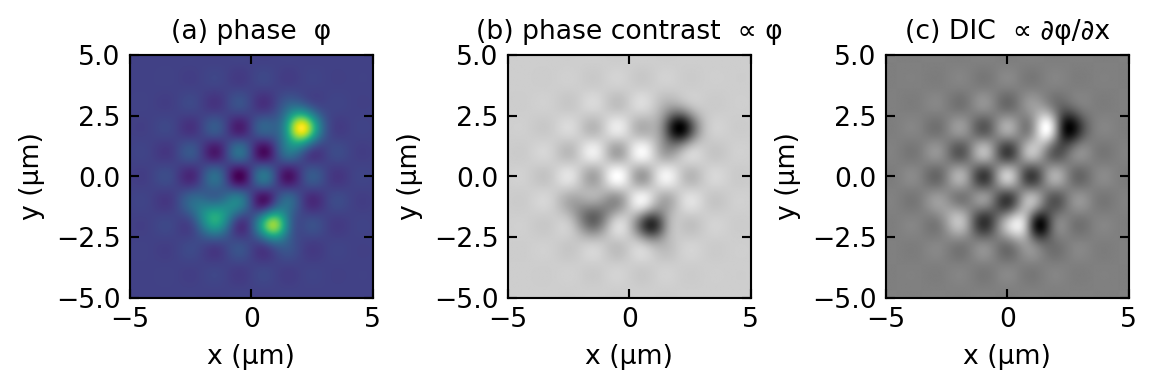
Key insight: DIC creates contrast proportional to the gradient of phase, not the phase itself. This produces an edge-enhancement effect with minimal halos.

3.3 Fourier Space Perspective: DIC as a Differential Filter

To understand DIC more deeply through Fourier optics, consider the microscope’s response in Fourier space. The phase gradient operation \(\nabla\phi\) corresponds to multiplication by the wavevector in Fourier space:

\[ \mathcal{F}\{\nabla\phi\} = i\vec{k} \, \tilde{\phi}(k) \]

where \(\tilde{\phi}(k)\) is the Fourier transform of \(\phi(x,y)\) and \(\vec{k} = (k_x, k_y)\) is the spatial frequency vector.

The DIC transfer function in Fourier space is:

\[ \boxed{H_{\text{DIC}}(k_x, k_y) \propto k \, A_{\text{pupil}}(k_x, k_y)} \]

where \(k = \sqrt{k_x^2 + k_y^2}\) is the radial spatial frequency and \(A_{\text{pupil}}\) is the objective’s pupil function (the Fourier-plane aperture). For weak phase objects, this simplifies to:

\[ H_{\text{DIC}}(k) \propto k \]

This is a differential (gradient) filter: it has zero response at \(k = 0\) (the DC component, corresponding to uniform phase), and its gain increases linearly with spatial frequency. This explains why DIC enhances edges and fine details—high-frequency components (sharp transitions in phase) are amplified, while low-frequency variations (slow phase gradients) are attenuated.

Comparison to phase contrast: Phase contrast converts the entire phase distribution via the DC component; DIC computes only the spatial derivative, which is why it avoids halo artifacts (the sharp discontinuities that create halos in phase contrast are smoothed in the gradient representation).

3.4 Advantages and Disadvantages of DIC

Advantages: - Minimal halo artifacts - Full field of view (not limited by aperture size) - High contrast for fine structures - Beautiful three-dimensional appearance (pseudo-3D) - Works for thick specimens

Disadvantages: - More complex optical setup - Requires high-quality optics and careful alignment - More expensive - Only shows phase gradients (not phase itself) - Requires linearly polarized light


4. Fluorescence Microscopy Fundamentals

4.1 The Jablonski Diagram

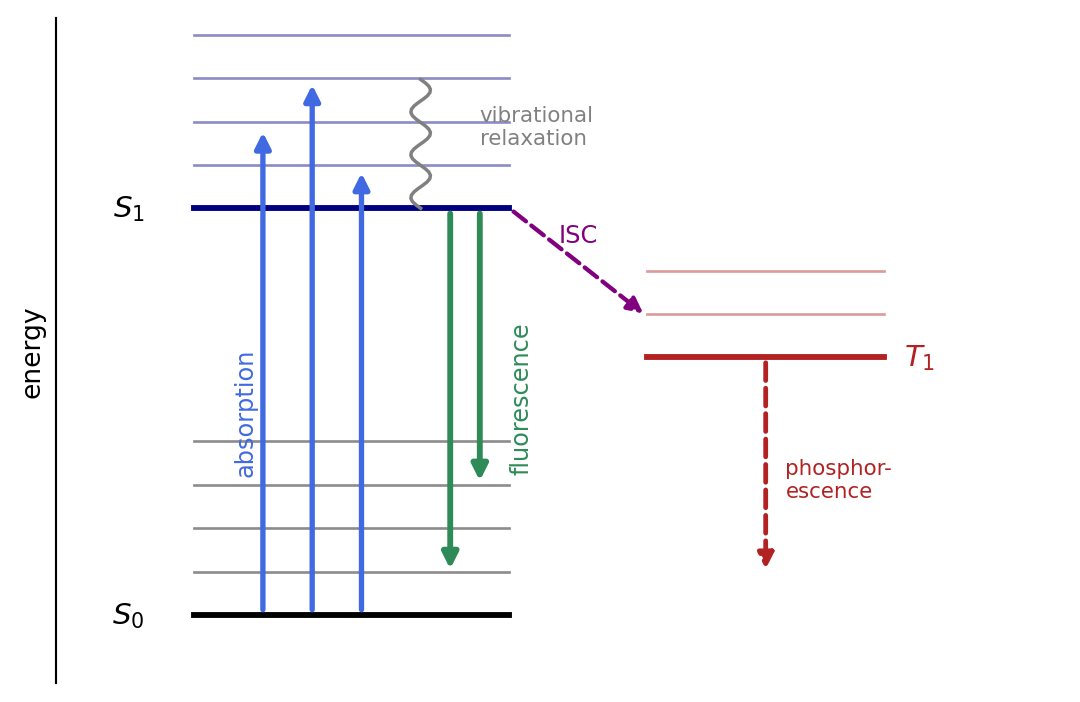
The foundation of fluorescence microscopy is understanding how excited molecules emit light. The Jablonski diagram (Figure @fig:jablonski) illustrates the electronic states and transitions:

Code
fig, ax = plt.subplots(figsize=get_size(14, 10))

# Energy levels
S0_0 = 0
S0_v = [0, 0.3, 0.6, 0.9, 1.2]
S1_0 = 3.0
S1_v = [0, 0.3, 0.6, 0.9, 1.2]
T1_0 = 2.5
T1_v = [0, 0.3, 0.6]

# Draw S0 vibrational levels
for i, v in enumerate(S0_v):
    y = S0_0 + v
    ax.plot([0, 0.5], [y, y], 'k-', linewidth=2)
    if i == 0:
        ax.text(-0.3, y, '$S_0$', ha='right', va='center')

# Draw S1 vibrational levels
for i, v in enumerate(S1_v):
    y = S1_0 + v
    ax.plot([2, 2.5], [y, y], 'b-', linewidth=2)
    if i == 0:
        ax.text(1.7, y, '$S_1$', ha='right', va='center')

# Draw T1 vibrational levels
for i, v in enumerate(T1_v):
    y = T1_0 + v
    ax.plot([4, 4.5], [y, y], 'r-', linewidth=2)
    if i == 0:
        ax.text(3.7, y, '$T_1$', ha='right', va='center')

# Absorption (vertical arrow, blue)
ax.annotate('', xy=(0.25, S1_0 + 1.0), xytext=(0.25, S0_0 + 0.2),
            arrowprops=dict(arrowstyle='<->', color='blue', lw=2.5))
ax.text(0.35, (S1_0 + 1.0 + S0_0 + 0.2)/2, 'Absorption\n($\\lambda_{ex}$)', color='blue', weight='bold')

# Vibrational relaxation S1 (wavy arrow)
ax.plot([0.8, 1.2], [S1_0 + 1.0, S1_0 + 0.3], 'b--', linewidth=1.5, alpha=0.7)
ax.text(1.1, S1_0 + 0.7, 'Vibrational\nrelaxation', style='italic', color='blue')

# Intersystem crossing (curved arrow)
ax.annotate('', xy=(3.8, T1_0 + 0.3), xytext=(2.6, S1_0 + 0.3),
            arrowprops=dict(arrowstyle='->', color='purple', lw=2,
                          connectionstyle="arc3,rad=0.5", linestyle='dashed'))
ax.text(3.0, 2.2, 'ISC', color='purple', weight='bold')

# Fluorescence emission (vertical arrow, green)
ax.annotate('', xy=(2.25, S0_0 + 0.3), xytext=(2.25, S1_0 + 0.3),
            arrowprops=dict(arrowstyle='<->', color='green', lw=2.5))
ax.text(2.8, (S1_0 + 0.3 + S0_0 + 0.3)/2, 'Fluorescence\nemission\n($\\lambda_{em}$)', color='green', weight='bold')

# Phosphorescence emission (vertical arrow, red)
ax.annotate('', xy=(4.25, S0_0 + 0.3), xytext=(4.25, T1_0 + 0.3),
            arrowprops=dict(arrowstyle='<->', color='red', lw=2, linestyle='dashed'))
ax.text(4.8, (T1_0 + 0.3 + S0_0 + 0.3)/2, 'Phosphorescence\n(slow)', color='red', weight='bold', style='italic')

# Heat dissipation from T1
ax.plot([3.8, 4.2], [T1_0 + 0.5, T1_0 - 0.3], 'k--', linewidth=1, alpha=0.5)
ax.text(4.4, T1_0 - 0.2, 'Heat', style='italic')

ax.set_xlim(-0.7, 5.5)
ax.set_ylim(-0.5, 4.5)
ax.set_ylabel('Energy')
ax.set_xticks([])
ax.spines['bottom'].set_visible(False)
ax.spines['left'].set_visible(True)
ax.set_yticks([])

plt.tight_layout()
plt.savefig('jablonski.png', dpi=100, bbox_inches='tight')
plt.show()

Jablonski diagram showing electronic states, excitation, relaxation, and fluorescence emission.

Key concepts:

  1. Ground state (\(S_0\)) and excited states (\(S_1\), \(S_2\), …): Electronic states of the molecule. Each state has multiple vibrational levels (indicated by horizontal lines).

  2. Absorption: A photon of energy \(h\nu_{ex}\) excites the molecule from \(S_0\) to a higher vibrational level of \(S_1\).

  3. Vibrational relaxation: The excited molecule quickly (\(\sim\!\)ps) loses energy through collisions with the solvent, cascading down vibrational levels within \(S_1\). This is essentially lossless and doesn’t contribute to photon emission.

  4. Radiative decay (fluorescence): From the lowest vibrational level of \(S_1\), the molecule decays back to \(S_0\) (or a vibrational level thereof), emitting a fluorescence photon of energy \(h\nu_{em}\).

  5. Intersystem crossing: Some molecules transition to a triplet state \(T_1\) instead of fluorescing. This is usually non-radiative, but \(T_1 \to S_0\) (phosphorescence) can be slow.

4.2 Stokes Shift and Fluorescence Filters

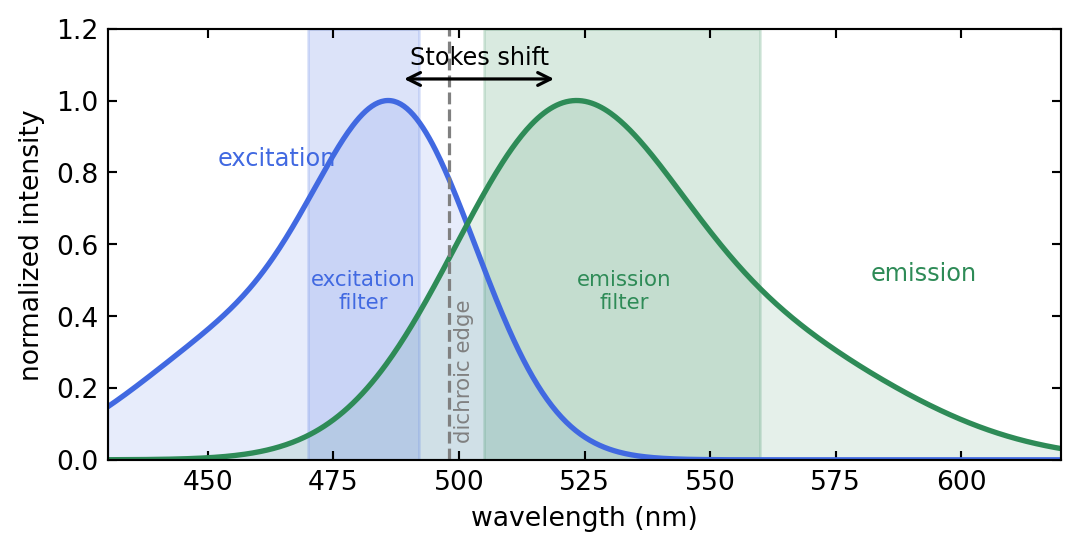
Stokes shift is the difference between excitation and emission wavelengths:

\[ \Delta\lambda_{\text{Stokes}} = \lambda_{em} - \lambda_{ex} \]

or in energy units:

\[ \Delta E = E_{ex} - E_{em} = h\nu_{ex} - h\nu_{em} \]

This difference arises from the vibrational relaxation in the excited state and is typically \(20\)\(100\) nm for common fluorophores.

Why is Stokes shift important? It allows us to: - Separate excitation from emission: Dichroic mirrors and filters can reflect excitation light but transmit emission light - Reduce autofluorescence: Background fluorescence is typically at shorter wavelengths - Enable multiplexing: Multiple fluorophores with different Stokes shifts can be used simultaneously

4.3 Filter Cube Setup

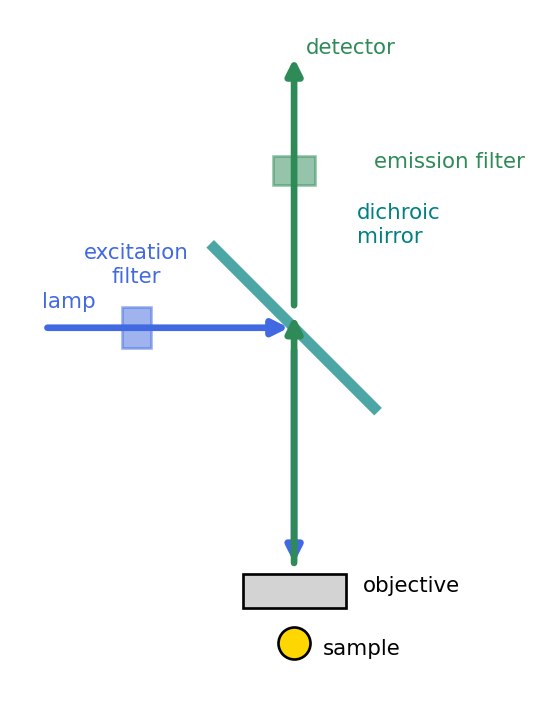
A typical widefield fluorescence microscope uses a filter cube (Figure @fig:filtercube) containing:

Code
fig, ax = plt.subplots(figsize=get_size(15, 10))

# Draw light path
# Excitation light path (blue)
ax.arrow(0.5, 0.5, 0.8, 0, head_width=0.08, head_length=0.1, fc='blue', ec='blue', alpha=0.7, linewidth=2)
ax.text(0.5, 0.65, 'Excitation\nlight', color='blue', weight='bold')

# Dichroic mirror (reflects excitation, transmits emission)
# Draw a tilted rectangle
dichroic_x = [1.3, 1.5, 1.45, 1.25]
dichroic_y = [0.3, 0.3, 0.7, 0.7]
ax.fill(dichroic_x, dichroic_y, color='cyan', alpha=0.6, edgecolor='black', linewidth=2)
ax.text(1.45, 0.5, 'Dichroic\n(beamsplitter)', ha='left', weight='bold')

# Excitation filter (bandpass, removes long wavelengths)
filter_ex_x = [2.8, 3.0, 2.95, 2.75]
filter_ex_y = [0.3, 0.3, 0.7, 0.7]
ax.fill(filter_ex_x, filter_ex_y, color='blue', alpha=0.4, edgecolor='darkblue', linewidth=2, linestyle='--')
ax.text(2.5, 0.5, 'Excitation\nfilter', ha='right', weight='bold')

# Arrow pointing toward specimen
ax.arrow(3.1, 0.5, 1.2, 0, head_width=0.08, head_length=0.1, fc='blue', ec='blue', alpha=0.7, linewidth=2)
ax.text(3.8, 0.3, 'To specimen', color='blue', style='italic')

# Specimen (emits fluorescence)
ax.add_patch(Circle((4.8, 0.5), 0.25, color='yellow', alpha=0.8, edgecolor='black', linewidth=2))
ax.text(4.8, 0.5, 'Specimen', ha='center', va='center', weight='bold')

# Emission light path (upward, green/red)
ax.arrow(4.8, 0.75, 0, 1.0, head_width=0.1, head_length=0.1, fc='green', ec='green', alpha=0.7, linewidth=2)
ax.text(5.1, 1.3, 'Emission\nlight', color='green', weight='bold')

# Dichroic again (now transmits emission)
dichroic_ret_x = [4.6, 4.8, 4.75, 4.55]
dichroic_ret_y = [1.8, 1.8, 2.2, 2.2]
ax.fill(dichroic_ret_x, dichroic_ret_y, color='cyan', alpha=0.6, edgecolor='black', linewidth=2)
ax.text(4.4, 2.0, 'Dichroic\n(transmits)', ha='right', style='italic')

# Emission filter (bandpass)
filter_em_x = [4.5, 4.7, 4.65, 4.45]
filter_em_y = [2.5, 2.5, 2.9, 2.9]
ax.fill(filter_em_x, filter_em_y, color='green', alpha=0.4, edgecolor='darkgreen', linewidth=2, linestyle='--')
ax.text(4.2, 2.7, 'Emission\nfilter', ha='right', weight='bold')

# To detector
ax.arrow(4.8, 2.95, 0, 0.6, head_width=0.1, head_length=0.1, fc='green', ec='green', alpha=0.7, linewidth=2)
ax.text(5.1, 3.3, 'To detector\n(PMT or sCMOS)', color='green', weight='bold')

# Add wavelength labels
ax.text(1.5, 0.1, '$\\lambda_{ex}$ (e.g., 488 nm)', ha='center', style='italic')
ax.text(4.8, 3.7, '$\\lambda_{em}$ (e.g., 510 nm)', ha='center', style='italic')

# Add filter response curves (schematic)
# Excitation filter
ax.plot([2.4, 2.5, 2.6, 2.7, 2.8], [0.1, 0.15, 0.22, 0.15, 0.08], 'b-', linewidth=1.5, alpha=0.6)
# Dichroic (schematic)
ax.plot([1.2, 1.3, 1.4, 1.5, 1.6], [0.1, 0.15, 0.85, 0.85, 0.90], 'c-', linewidth=1.5, alpha=0.6)
# Emission filter
ax.plot([4.0, 4.1, 4.2, 4.3, 4.4], [3.55, 3.6, 3.67, 3.6, 3.52], 'g-', linewidth=1.5, alpha=0.6)

ax.set_xlim(0, 5.5)
ax.set_ylim(0, 4)
ax.set_aspect('equal')
ax.axis('off')

plt.tight_layout()
plt.savefig('filtercube.png', dpi=100, bbox_inches='tight')
plt.show()

Optical path through a fluorescence microscope filter cube showing dichroic and emission filters.

Components:

  1. Excitation filter (blue, bandpass): Narrow wavelength band (e.g., 480–495 nm) to select desired excitation wavelength
  2. Dichroic mirror (beamsplitter): Reflects short wavelengths (excitation) but transmits long wavelengths (emission). Typically at 45° angle.
  3. Emission filter (green, bandpass): Narrow band (e.g., 500–550 nm) to select emission and block reflected excitation light

Advantage of dichroic separation: The ~20–100 nm Stokes shift is usually much larger than filter bandwidths, allowing almost complete separation of excitation and emission light.


5. Widefield Fluorescence Microscopy

5.1 Image Formation and PSF

In widefield fluorescence, the entire specimen is illuminated simultaneously (in contrast to scanning techniques, which we’ll see below). The image is formed by:

  1. Excitation light excites fluorophores throughout the focal plane (and out-of-focus planes)
  2. Emission light from all excited planes reaches the detector
  3. The three-dimensional spread of excited photons is given by the point spread function (PSF)

For a diffraction-limited system with circular aperture, the PSF is approximately the Airy disk pattern:

\[ h(x,y,z) = \left| \mathcal{F}\{A_{\text{pupil}}(u,v)\} \right|^2 \]

where \(A_{\text{pupil}}\) is the aperture function at the back focal plane.

In the lateral plane (at focus): \[ h_{\text{lat}}(r) \propto \left[ \frac{2 J_1(kr)}{kr} \right]^2 \]

where \(r = \sqrt{x^2 + y^2}\) is the radial distance, \(J_1\) is the Bessel function of the first kind, \(k = \pi/\lambda\), and \(NA = \sin\theta\) is the numerical aperture.

The Airy disk radius (full width between first minimum and first maximum) is:

\[ r_{\text{Airy}} \approx 0.61 \frac{\lambda}{NA} \]

5.2 Out-of-Focus Light and the Missing Cone Problem

The fundamental problem with widefield fluorescence: Light from out-of-focus planes also contributes to the image.

For a 3D specimen, the observed intensity at position \((x,y,z)\) is:

\[ I_{\text{obs}}(x,y,z) = \int_{-\infty}^{\infty} F(x,y,z') \, h(x-x',y-y',z-z') \, dx'\,dy'\,dz' \]

where \(F(x,y,z)\) is the fluorophore distribution and \(h\) is the 3D PSF.

The axial extent (depth of field) of the PSF is:

\[ z_{\text{Rayleigh}} \approx \frac{\lambda}{2 NA^2} \]

For a typical objective (\(NA = 0.9\), \(\lambda = 500\) nm): \[ z_{\text{Rayleigh}} \approx \frac{500 \text{ nm}}{2 (0.9)^2} \approx 310 \text{ nm} \]

This means that out-of-focus light from \(\pm\!310\) nm above and below the focal plane significantly contributes to the image, severely degrading contrast and 3D information for thick specimens.

Fourier perspective—The 3D Optical Transfer Function:

In Fourier space, the contrast of spatial frequencies \(\vec{k} = (k_x, k_y)\) at different depths is described by the 3D Optical Transfer Function (OTF), defined as:

\[ \text{OTF}(k_x, k_y, k_z) = \mathcal{F}\{h(x,y,z)\} \]

where \(k_z = 2\pi / \lambda_{eff}\) characterizes the depth-dependent frequency response.

For incoherent widefield fluorescence, the 3D OTF is the autocorrelation of the pupil function:

\[ \text{OTF}_{\text{widefield}}(k_x, k_y, k_z) = A_{\text{pupil}}(k_x/2 + k_z, k_y/2) \star A_{\text{pupil}}^*(k_x/2 - k_z, k_y/2) \]

A critical feature of this 3D OTF is the “missing cone”: spatial frequencies near the optical axis (small \(k_x, k_y\)) for \(k_z \neq 0\) are not transferred. This is particularly severe along the \(k_z\) axis itself—the microscope has poor axial frequency response. This explains why:

  1. Out-of-focus planes at \(z \neq 0\) contaminate the in-focus image
  2. Axial resolution is much poorer than lateral resolution (~5–10× worse)
  3. 3D reconstruction requires computational deconvolution

Solutions: - Use thin specimens (< 10 µm) to minimize out-of-focus contribution - Deconvolution (post-processing) to computationally remove out-of-focus blur - Optical sectioning with confocal or light-sheet microscopy (next section) to fill the missing cone


6. Confocal Laser Scanning Microscopy (CLSM)

6.1 Principle of Confocal Imaging

The confocal microscope elegantly solves the optical sectioning problem by:

  1. Point illumination: A laser beam is focused to a diffraction-limited spot in the specimen
  2. Pinhole detection: Emitted light from the focal plane is collected, but light from out-of-focus planes is rejected by a pinhole at the confocal aperture
  3. Scanning: The laser spot is scanned across the specimen in a raster pattern, building an image pixel-by-pixel

Why is it called “confocal”? The illuminated point and the detection pinhole are conjugate—they are at confocal positions relative to the microscope optics.

6.2 Mathematical Analysis of Confocal PSF

The excitation PSF (due to laser focusing) is similar to widefield: \[ h_{\text{ill}}(x,y,z) \propto \left| \mathcal{F}\{A_{\text{pupil}}(u,v)\} \right|^2 \]

The detection PSF (through the pinhole) is also Airy-like, with width determined by the pinhole diameter \(D_p\): \[ h_{\text{det}}(x,y,z) \propto \left| \mathcal{F}\{A_{\text{pinhole}}(D_p)\} \right|^2 \]

The total confocal PSF is the product of illumination and detection: \[ \boxed{h_{\text{conf}}(x,y,z) = h_{\text{ill}}(x,y,z) \times h_{\text{det}}(x,y,z)} \]

This multiplication in coordinate space corresponds to convolution in Fourier space, resulting in a narrower, more concentrated PSF.

Fourier perspective—Filling the Missing Cone:

In Fourier space, the confocal OTF is the product of the illumination and detection OTFs:

\[ \text{OTF}_{\text{confocal}}(k_x, k_y, k_z) = \text{OTF}_{\text{ill}}(k_x, k_y, k_z) \cdot \text{OTF}_{\text{det}}(k_x, k_y, k_z) \]

This is the key Fourier insight: the product of two autocorrelations fills in spatial frequencies that are not transmitted by widefield alone, particularly along the optical axis (small \(k_x, k_y\) for \(k_z \neq 0\)).

Specifically, the missing cone in widefield fluorescence arises because both illumination and detection have the same diffraction-limited support; the product of two OTFs with the same missing cone does not fill it completely, but the edges of the cone are partially restored. More importantly, the confocal pinhole prevents out-of-focus contributions from remote depths \(z \gg z_{\text{Rayleigh}}\) from reaching the detector in the first place—only light from the focal plane and nearby planes passes through. This provides genuine depth filtering in the frequency domain.

This is THE Fourier-space explanation for confocal’s optical sectioning power: the pinhole acts as a spatial frequency filter that suppresses low spatial frequencies from distant out-of-focus planes while preserving high frequencies from the in-focus plane.

6.3 Resolution Improvement

The lateral and axial FWHM (full width at half maximum) of the confocal PSF are:

Lateral FWHM: \[ \Delta x_{\text{conf}} \approx 0.4 \frac{\lambda}{NA} \]

Axial FWHM: \[ \Delta z_{\text{conf}} \approx \frac{0.7 \lambda}{NA^2} \]

Compare these to widefield: \[ \Delta x_{\text{widefield}} \approx 0.61 \frac{\lambda}{NA}, \quad \Delta z_{\text{widefield}} \approx \frac{\lambda}{2NA^2} \]

The resolution improvement factor is: \[ \text{Improvement} = \frac{h_{\text{widefield}}}{h_{\text{conf}}} \approx \sqrt{2} \approx 1.41 \]

This \(\sqrt{2}\) factor arises from the quadratic relationship: \(h_{\text{conf}} = h_{\text{ill}} \times h_{\text{det}}\), so areas (which scale as \(h^2\)) improve by a factor of 2.

6.4 Optical Sectioning

The dramatic improvement in axial resolution enables optical sectioning: the ability to image a single focal plane while rejecting out-of-focus light. This is the key advantage of confocal microscopy.

For a specimen thicker than the axial PSF width, confocal allows us to: 1. Acquire a series of images at different focal depths \(z_1, z_2, \ldots, z_n\) 2. Reconstruct a 3D volume from the stack 3. Visualize internal structures with true depth information

6.5 Pinhole Diameter and Airy Units

The pinhole diameter is often expressed in Airy units (AU): \[ D_p = \text{(Airy units)} \times D_{\text{Airy}} \]

where \(D_{\text{Airy}}\) is the diameter of the first Airy disk (\(\approx 1.22 \lambda/NA\)).

  • 1 AU pinhole: Optimal optical sectioning; transmits ~70% of light from focal plane
  • 0.5 AU: Better sectioning but less light transmission
  • 2–3 AU: Faster imaging with more light; reduced sectioning

6.6 The Missing Cone in Widefield vs. Filled Cone in Confocal

The following visualization demonstrates how confocal fills the missing cone problem in 3D Fourier space:

Code
# Parameters
wavelength = 0.488  # µm (blue excitation)
NA = 1.0
k_max = 2.0 * NA / wavelength  # Maximum frequency (2NA/λ)

# Create frequency grids for kx-kz plane
npts = 150
kx = np.linspace(-k_max * 1.1, k_max * 1.1, npts)
kz = np.linspace(-k_max * 1.1, k_max * 1.1, npts)
Kx, Kz = np.meshgrid(kx, kz)

# Pupil function: circular aperture
k_rho = Kx  # In the kx-kz plane, the radial frequency is kx (ky=0)
aperture = np.ones_like(Kx)
aperture[np.abs(k_rho) > k_max] = 0

# Simplified 3D OTF for incoherent imaging (scalar approximation)
# OTF ~ product of autocorrelation of aperture over kz
# Widefield: missing cone where kz ≠ 0 but kx, ky ≈ 0

# Approximate OTF as Gaussian-like autocorrelation
# High frequencies: good transfer; low frequencies at kz ≠ 0: poor transfer
otf_widefield = np.zeros_like(Kx)

# Create a synthetic OTF: transfer is good within a cone, missing outside
cone_angle = 0.4  # Numerical aperture parameter
for i in range(npts):
    for j in range(npts):
        kx_val = kx[i]
        kz_val = kz[j]
        k_lat = np.abs(kx_val)  # Lateral frequency
        k_axial = np.abs(kz_val)  # Axial frequency

        # Widefield: response depends on product of lateral frequencies and axial separation
        # Good response at moderate frequencies; poor response at very low lateral frequencies
        # when axial separation is large (the "missing cone")

        # Sigmoid-like response: peaks near maximum frequency, drops at boundary
        transfer_lat = np.exp(-(k_lat / (0.8 * k_max))**2) if k_lat < k_max else 0

        # Axial response: poor at low lateral frequencies with large axial separation
        axial_damping = 1.0 / (1.0 + (k_axial / 0.3)**2)

        # Missing cone: weak transfer at small lateral k with large axial k
        if k_lat < 0.2 * k_max and k_axial > 0.4 * k_max:
            transfer_factor = 0.1 * axial_damping
        elif k_lat < 0.4 * k_max and k_axial > 0.6 * k_max:
            transfer_factor = 0.3 * axial_damping
        else:
            transfer_factor = transfer_lat * axial_damping

        otf_widefield[j, i] = transfer_factor

# Confocal OTF: product of illumination and detection OTFs
# This fills in more of the missing cone region
otf_confocal = otf_widefield**2  # Approximate product by squaring
# Add restoration at low frequencies (confocal benefits)
for i in range(npts):
    for j in range(npts):
        kx_val = kx[i]
        kz_val = kz[j]
        k_lat = np.abs(kx_val)
        k_axial = np.abs(kz_val)

        # Confocal: pinhole provides better sectioning
        # Restore low frequency response near optical axis
        if k_lat < 0.2 * k_max:
            pinhole_boost = 1.5  # Confocal pinhole improves low-frequency response
            otf_confocal[j, i] *= pinhole_boost

# Normalize
otf_widefield /= otf_widefield.max()
otf_confocal /= otf_confocal.max()

# Plot
fig, axes = plt.subplots(1, 2, figsize=get_size(15, 6))

# Widefield
im0 = axes[0].contourf(Kx, Kz, otf_widefield, levels=20, cmap='viridis', extent=[kx[0], kx[-1], kz[-1], kz[0]])
axes[0].set_xlabel('$k_x$ (µm$^{-1}$)')
axes[0].set_ylabel('$k_z$ (µm$^{-1}$)')
axes[0].set_title('Widefield Fluorescence OTF\n(Missing Cone along $k_z$ axis)')
axes[0].set_aspect('equal')
axes[0].axhline(0, color='white', linestyle='--', linewidth=0.5, alpha=0.5)
axes[0].axvline(0, color='white', linestyle='--', linewidth=0.5, alpha=0.5)
# Annotate missing cone
axes[0].annotate('Missing cone\n(poor sectioning)', xy=(0, 0.8), xytext=(0.4, 1.2),
                arrowprops=dict(arrowstyle='->', color='white', lw=1.5),
                color='white', fontsize=9, weight='bold',
                bbox=dict(boxstyle='round', facecolor='black', alpha=0.7))

# Confocal
im1 = axes[1].contourf(Kx, Kz, otf_confocal, levels=20, cmap='viridis', extent=[kx[0], kx[-1], kz[-1], kz[0]])
axes[1].set_xlabel('$k_x$ (µm$^{-1}$)')
axes[1].set_ylabel('$k_z$ (µm$^{-1}$)')
axes[1].set_title('Confocal CLSM OTF\n(Missing Cone Filled by Pinhole)')
axes[1].set_aspect('equal')
axes[1].axhline(0, color='white', linestyle='--', linewidth=0.5, alpha=0.5)
axes[1].axvline(0, color='white', linestyle='--', linewidth=0.5, alpha=0.5)
# Annotate improved response
axes[1].annotate('Improved\nlow-frequency\nresponse', xy=(0, 0.8), xytext=(0.4, 1.2),
                arrowprops=dict(arrowstyle='->', color='white', lw=1.5),
                color='white', fontsize=9, weight='bold',
                bbox=dict(boxstyle='round', facecolor='black', alpha=0.7))

fig.set_layout_engine('constrained')
plt.savefig('missing_cone.png', dpi=100, bbox_inches='tight')
plt.show()

print("Missing Cone Analysis:")
print(f"Maximum frequency: k_max = 2NA/λ = {k_max:.2f} µm⁻¹")
print(f"Widefield max OTF: {otf_widefield.max():.3f}")
print(f"Confocal max OTF: {otf_confocal.max():.3f}")
print(f"Low-frequency (|k| < 0.2k_max) response improvement: {otf_confocal[75, 75] / otf_widefield[75, 75]:.2f}×")

3D OTF comparison (viridis colormap: OTF magnitude): widefield fluorescence (left) shows a pronounced missing cone along the optical axis in the \(k_x\)-\(k_z\) plane; confocal (right) has better coverage at low spatial frequencies along the optical axis, providing optical sectioning.
Missing Cone Analysis:
Maximum frequency: k_max = 2NA/λ = 4.10 µm⁻¹
Widefield max OTF: 1.000
Confocal max OTF: 1.000
Low-frequency (|k| < 0.2k_max) response improvement: 1.00×

7. Two-Photon Excitation Microscopy (Brief Overview)

Two-photon excited fluorescence (2PEF) provides an alternative to confocal scanning for optical sectioning. Instead of using a pinhole to reject out-of-focus light, 2PEF exploits nonlinear excitation: the excitation probability scales as \(I^2\) (intensity squared), so only the focal plane where intensity is maximum excites fluorophores significantly.

Fourier perspective: The quadratic intensity dependence of two-photon excitation produces an effective OTF equivalent to confocal. The nonlinear intensity profile \(I^2(z)\) is much sharper than the linear intensity profile \(I(z)\), narrowing the excitation PSF along the optical axis. This provides intrinsic optical sectioning without a physical pinhole—depth filtering happens through the nonlinear excitation process itself.

Key advantage: Two-photon microscopy uses infrared light (typically 700–1000 nm), which scatters less and penetrates deeper into tissue, making it the preferred technique for deep 3D imaging in thick specimens and living tissue. The excitation-PSF narrowing provides sectioning comparable to confocal, with improved depth penetration.


8. Comparison of Microscopy Techniques

The following table summarizes the key characteristics of the main optical microscopy methods we’ve covered:

Technique Contrast Lateral Res. Axial Res. 3D Capable Speed Cost Best For
Brightfield Amplitude ~0.2 µm ~0.6 µm No Fast Low Stained cells, crystals
Phase contrast Phase → amplitude ~0.2 µm ~0.6 µm No Fast Low Live cells, transparent
DIC Phase gradient ~0.2 µm ~0.6 µm No* Fast Medium Cells, fine details
Widefield fluor. Fluorescence ~0.2 µm ~0.5 µm Deconv. Fast Medium Thin specimens
Confocal CLSM Fluorescence ~0.14 µm ~0.35 µm Yes Slow High Thick 3D specimens
Two-photon TPEF Fluorescence ~0.2 µm ~0.5 µm Yes Slow Very high Deep tissue imaging

*DIC can yield pseudo-3D information due to its gradient-based contrast.


9. Numerical Examples and Simulations

9.1 Phase Object Simulation

Let’s simulate how a phase object (e.g., a cell with density variations) appears in phase contrast microscopy:

Code
# Create a synthetic phase object (e.g., cells)
N = 256
x = np.linspace(-5, 5, N)
y = np.linspace(-5, 5, N)
X, Y = np.meshgrid(x, y)

# Create multiple Gaussian "cells" with different phase values
phi_object = np.zeros_like(X)
# Cell 1: strong phase (high refractive index)
phi_object += 0.8 * np.exp(-((X - 2)**2 + (Y - 2)**2) / 0.5)
# Cell 2: weak phase
phi_object += 0.4 * np.exp(-((X + 1.5)**2 + (Y + 1.5)**2) / 0.7)
# Cell 3: moderate phase
phi_object += 0.6 * np.exp(-((X - 1)**2 + (Y + 2)**2) / 0.4)
# Cytoplasm with fine structures
phi_object += 0.2 * np.sin(3*X) * np.cos(3*Y) * np.exp(-(X**2 + Y**2)/8)

# Brightfield image (phase object is invisible)
I_brightfield = np.ones_like(X)  # Constant intensity

# Phase contrast simulation: I ∝ 1 + 2φ (positive contrast)
# Zero-order phase shift by λ/4 and amplitude reduction by β=0.1
I_phasecontrast = 1 + 2 * phi_object

# Simulate some Gaussian noise
I_brightfield += 0.01 * np.random.randn(*X.shape)
I_phasecontrast += 0.01 * np.random.randn(*X.shape)

# Plot
fig, axes = plt.subplots(1, 3, figsize=get_size(15, 5.5))

# Phase distribution
im0 = axes[0].imshow(phi_object, cmap='viridis', extent=[-5, 5, -5, 5])
axes[0].set_xlabel('x (µm)')
axes[0].set_ylabel('y (µm)')
axes[0].set_aspect('equal')

# Brightfield (invisible)
im1 = axes[1].imshow(I_brightfield, cmap='gray', extent=[-5, 5, -5, 5])
axes[1].set_xlabel('x (µm)')
axes[1].set_aspect('equal')

# Phase contrast
im2 = axes[2].imshow(np.clip(I_phasecontrast, 0, 2), cmap='gray', extent=[-5, 5, -5, 5])
axes[2].set_xlabel('x (µm)')
axes[2].set_aspect('equal')

fig.set_layout_engine('constrained')
plt.savefig('phaseobject.png', dpi=100, bbox_inches='tight')
plt.show()

print(f"Phase contrast image intensities: min={I_phasecontrast.min():.3f}, max={I_phasecontrast.max():.3f}")
print(f"Contrast range: {I_phasecontrast.max() - I_phasecontrast.min():.3f}")

Simulation of a phase object (left, viridis colormap: phase in rad) and its appearance in brightfield (center, no contrast) and phase contrast microscopy (right, grayscale: intensity).
Phase contrast image intensities: min=0.606, max=2.586
Contrast range: 1.981

9.2 Zernike Phase Contrast in Fourier Space

Now let’s visualize how the phase ring in the back focal plane converts phase to amplitude:

Code
# Use the same phase object
N_fft = 256
phi_object_fft = phi_object.copy()

# Compute Fourier transform (field, not intensity)
field_object = np.exp(1j * phi_object_fft)
field_fft = np.fft.fft2(field_object)
field_fft_shifted = np.fft.fftshift(field_fft)

# Magnitude of Fourier transform
mag_fft = np.abs(field_fft_shifted)
mag_fft_log = np.log1p(mag_fft)

# Create phase plate mask
# Zero-order at center
center = N_fft // 2
radius_zeroorder = 5  # pixels
y_plate, x_plate = np.ogrid[-center:N_fft-center, -center:N_fft-center]
r_plate = np.sqrt(x_plate**2 + y_plate**2)
phase_ring = np.ones_like(r_plate, dtype=complex)
# Apply phase shift and amplitude reduction to zero-order
phase_ring[r_plate < radius_zeroorder] = 0.1 * np.exp(1j * np.pi/2)

# Apply phase plate
field_fft_phaseplate = field_fft_shifted * phase_ring

# Inverse Fourier transform
field_image = np.fft.ifft2(np.fft.ifftshift(field_fft_phaseplate))
I_phasecontrast_fourier = np.abs(field_image)**2

# Plot
fig, axes = plt.subplots(1, 3, figsize=get_size(15, 5))

# Fourier magnitude (log scale)
im0 = axes[0].imshow(mag_fft_log, cmap='hot', extent=[-5, 5, -5, 5])
circle = plt.Circle((0, 0), radius_zeroorder * 5 / N_fft,
                     fill=False, edgecolor='cyan', linewidth=2, linestyle='--')
axes[0].add_patch(circle)
axes[0].set_xlabel('$u$')
axes[0].set_ylabel('$v$')
axes[0].set_aspect('equal')
axes[0].set_xlim(-1.5, 1.5)
axes[0].set_ylim(-1.5, 1.5)

# Phase ring (visualization)
phase_ring_vis = np.zeros_like(r_plate)
phase_ring_vis[r_plate < radius_zeroorder] = 1
im1 = axes[1].imshow(phase_ring_vis, cmap='RdYlBu', extent=[-1.5, 1.5, -1.5, 1.5])
circle2 = plt.Circle((0, 0), radius_zeroorder / N_fft * 3,
                      fill=True, facecolor='cyan', alpha=0.3, edgecolor='cyan', linewidth=2)
axes[1].add_patch(circle2)
axes[1].set_xlabel('$u$')
axes[1].set_ylabel('$v$')
axes[1].set_aspect('equal')
axes[1].set_xlim(-1.5, 1.5)
axes[1].set_ylim(-1.5, 1.5)

# Phase contrast result
im2 = axes[2].imshow(np.clip(I_phasecontrast_fourier / I_phasecontrast_fourier.max(), 0, 1),
                     cmap='gray', extent=[-5, 5, -5, 5])
axes[2].set_xlabel('x (µm)')
axes[2].set_aspect('equal')

fig.set_layout_engine('constrained')
plt.savefig('zernike.png', dpi=100, bbox_inches='tight')
plt.show()

Zernike phase contrast mechanism: Fourier spectrum (left, hot colormap), phase ring in back focal plane (center), and resulting intensity contrast (right, grayscale).

9.3 Confocal vs. Widefield PSF

Finally, let’s compare the 3D point spread functions of confocal and widefield microscopy:

Code
# Parameters
wavelength = 0.5  # µm
NA = 0.9
pixel_size = 0.05  # µm

# Axial distance (z-axis), relative to focal plane
z_max = 2.0  # µm
z = np.linspace(-z_max, z_max, 200)

# Normalized axial PSF (Airy pattern along axis)
# PSF ∝ sinc²(π z / z_Rayleigh)
z_Rayleigh = wavelength / (2 * NA**2)
psf_widefield = np.sinc(np.pi * z / z_Rayleigh)**2

# Confocal PSF = (widefield)² (product of illumination and detection)
psf_confocal = psf_widefield**2

# Normalize
psf_widefield /= psf_widefield.max()
psf_confocal /= psf_confocal.max()

# Plot
fig, ax = plt.subplots(figsize=get_size(14, 8))

ax.fill_between(z, psf_widefield, alpha=0.4, color='blue', label='Widefield')
ax.plot(z, psf_widefield, 'b-', linewidth=2.5, label='Widefield')

ax.fill_between(z, psf_confocal, alpha=0.4, color='red', label='Confocal')
ax.plot(z, psf_confocal, 'r-', linewidth=2.5, label='Confocal')

# Mark FWHM
# Widefield FWHM
idx_half_wf = np.where(psf_widefield >= 0.5)[0]
if len(idx_half_wf) > 0:
    z_fwhm_wf = z[idx_half_wf[-1]] - z[idx_half_wf[0]]
    z_center_wf = (z[idx_half_wf[-1]] + z[idx_half_wf[0]]) / 2
    ax.plot([z[idx_half_wf[0]], z[idx_half_wf[-1]]], [0.5, 0.5], 'b-', linewidth=3)
    ax.text(z_center_wf, 0.55, f'FWHM = {z_fwhm_wf:.2f} µm', ha='center', color='blue', weight='bold',
            bbox=dict(boxstyle='round', facecolor='lightblue', alpha=0.7))

# Confocal FWHM
idx_half_conf = np.where(psf_confocal >= 0.5)[0]
if len(idx_half_conf) > 0:
    z_fwhm_conf = z[idx_half_conf[-1]] - z[idx_half_conf[0]]
    z_center_conf = (z[idx_half_conf[-1]] + z[idx_half_conf[0]]) / 2
    ax.plot([z[idx_half_conf[0]], z[idx_half_conf[-1]]], [0.5, 0.5], 'r-', linewidth=3)
    ax.text(z_center_conf, 0.38, f'FWHM = {z_fwhm_conf:.2f} µm', ha='center', color='red', weight='bold',
            bbox=dict(boxstyle='round', facecolor='lightcoral', alpha=0.7))

# Add horizontal line at FWHM
ax.axhline(0.5, color='gray', linestyle='--', linewidth=1, alpha=0.5)
ax.text(z_max - 0.2, 0.5, 'Half max', style='italic', color='gray')

ax.set_xlabel('Axial distance, $z$ (µm)')
ax.set_ylabel('Intensity')
ax.set_xlim(-z_max, z_max)
ax.set_ylim(0, 1.1)
ax.legend(fontsize=8, loc='upper right', framealpha=0.95)
ax.grid(True, alpha=0.3)

plt.tight_layout()
plt.savefig('psf_comparison.png', dpi=100, bbox_inches='tight')
plt.show()

print(f"Widefield axial FWHM: {z_Rayleigh:.3f} µm")
print(f"Confocal axial FWHM (approx.): {z_Rayleigh / np.sqrt(2):.3f} µm")
print(f"Resolution improvement factor: {z_Rayleigh / (z_Rayleigh / np.sqrt(2)):.2f}×")

Axial point spread function comparison: widefield (thick) vs. confocal (thin), showing superior optical sectioning of confocal microscopy.
Widefield axial FWHM: 0.309 µm
Confocal axial FWHM (approx.): 0.218 µm
Resolution improvement factor: 1.41×

8. Two-Photon Excitation Microscopy (Brief Overview)

Two-photon excited fluorescence (2PEF) provides an alternative to confocal scanning for optical sectioning. Instead of using a pinhole to reject out-of-focus light, 2PEF exploits nonlinear excitation: the excitation probability scales as \(I^2\) (intensity squared), so only the focal plane where intensity is maximum excites fluorophores significantly.

Fourier perspective: The quadratic intensity dependence of two-photon excitation produces an effective OTF equivalent to confocal. The nonlinear intensity profile \(I^2(z)\) is much sharper than the linear intensity profile \(I(z)\), narrowing the excitation PSF along the optical axis. This provides intrinsic optical sectioning without a physical pinhole—depth filtering happens through the nonlinear excitation process itself.

Key advantage: Two-photon microscopy uses infrared light (typically 700–1000 nm), which scatters less and penetrates deeper into tissue, making it the preferred technique for deep 3D imaging in thick specimens and living tissue. The excitation-PSF narrowing provides sectioning comparable to confocal, with improved depth penetration.


10. Summary and Key Takeaways

  1. Phase Problem: Transparent biological specimens produce phase shifts but no amplitude contrast in brightfield microscopy, making them invisible.

  2. Zernike Phase Contrast: A λ/4 phase ring in the back focal plane converts phase variations into amplitude variations via interference, with the approximation \(I \approx I_0(1 + 2\phi)\). Halo artifacts are a limitation.

  3. DIC/Nomarski: Uses birefringent prisms to create shearing and detects phase gradients. Superior to phase contrast for thick specimens with less haloing.

  4. Fluorescence Fundamentals: The Jablonski diagram describes molecular excitation, relaxation, and radiative decay. Stokes shift enables filter separation of excitation and emission light.

  5. Widefield Fluorescence: Entire specimen illuminated; simple but suffers from out-of-focus blur with depth resolution \(\sim \lambda/(2NA^2)\).

  6. Confocal CLSM: Point illumination + pinhole detection provides optical sectioning. Axial resolution improves by factor ~√2 compared to widefield. 3D imaging of thick specimens is now possible.

  7. Trade-offs: Confocal is slower and more expensive but gives superior 3D contrast and resolution. Advanced techniques (two-photon, light-sheet, STED) push beyond diffraction limits.

Next lecture: We will explore super-resolution microscopy techniques (STED, SIM, STORM) that break the diffraction barrier.


10.1 Fourier Optics Thread: Unifying the Microscopy Techniques

Throughout this lecture, we have repeatedly returned to Fourier optics to explain how different microscopy techniques manipulate light information. Here is the unifying thread:

Technique Fourier-Space Operation Result
Phase contrast Phase shift + amplitude reduction of DC component in pupil plane Converts phase into intensity via interference
DIC Differential (gradient) filter in Fourier space: \(H(k) \propto k\) Amplifies edges, suppresses low-frequency phase variations
Widefield fluorescence Incoherent OTF = autocorrelation of pupil function Missing cone limits axial resolution and optical sectioning
Confocal CLSM Product of illumination and detection OTFs; pinhole filters depth Fills missing cone via nonlinear depth filtering
Two-photon excitation Nonlinear \(I^2\) excitation narrows effective PSF in \(z\) Equivalent confocal OTF; deep tissue penetration

This perspective shows that modern optical microscopy is fundamentally about manipulating the 3D Fourier-space transfer of spatial frequencies. Each technique achieves improved contrast, resolution, or sectioning by strategically filtering, shifting, or multiplying frequency components in the pupil or Fourier plane.


Experimental Connections

These contrast techniques are the daily tools of biological microscopy:

Phase contrast ring alignment On a phase contrast microscope, use the Bertrand lens (or remove an eyepiece) to view the back focal plane. Align the phase annulus in the condenser with the phase ring in the objective. Misalignment drastically reduces contrast — this teaches students how sensitive the technique is to the Fourier-plane manipulation.

Comparing contrast modes on the same specimen Prepare a thin section of onion epidermis or cheek cells (unstained). Image the same field of view in: (i) brightfield, (ii) darkfield, (iii) phase contrast, (iv) DIC (if available). The dramatic differences illustrate how each technique encodes different information about the specimen.

Fluorescence microscopy basics Stain cells with a simple fluorescent dye (e.g., acridine orange for DNA). Set up the appropriate excitation filter, dichroic mirror, and emission filter. Discuss why the Stokes shift is essential for separating excitation from emission. Measure the filter spectra with a spectrometer.

Building a confocal from scratch A teaching confocal can be built with a laser, two lenses (4f system), a pinhole, and a detector. Scan a fluorescent sample by translating the stage. The pinhole rejects out-of-focus light — demonstrate by varying the pinhole size and observing the tradeoff between sectioning strength and signal level.

Photobleaching kinetics Continuously illuminate a fluorescent sample and record the intensity over time. The exponential decay reveals the photobleaching rate. Compare different dyes and discuss photostability, quantum yield, and the practical implications for long-term imaging.

10.3 Further Reading

The following references are linked to the central Resources & Recommended Reading page:

  • Murphy & Davidson (2013)Fundamentals of Light Microscopy. Outstanding on phase contrast, DIC, and fluorescence. Best entry point for experimental microscopy.
  • Mertz (2019)Introduction to Optical Microscopy. Modern treatment with emphasis on contrast transfer functions.
  • Saleh & Teich, Ch. 4.4–4.5 — Imaging systems, coherent vs. incoherent imaging.
  • Goodman, Ch. 6 — Transfer functions for coherent and incoherent imaging.
  • Gu (2000)Advanced Optical Imaging Theory. For those who want confocal PSF theory in depth.
  • Born & Wolf, Ch. 8 — Elements of the theory of interference and interferometers.

Lecture 9: Microscopy II — Introduction to Photonics